Author: Lawrence Tang

  • Golden Retriever AI Portraits: Capturing That Smile

    Golden Retriever AI Portraits: Capturing That Smile

    Golden Retriever AI Portraits: Capturing That Smile

    That goofy, tongue-out, pure-joy Golden Retriever smile — you know the one. It’s in 10,000 photos on your phone, but somehow none of them feel special enough to frame. The lighting’s off, the background’s cluttered, or it just doesn’t capture the personality behind those eyes.

    Now you can turn that everyday snapshot into museum-worthy art. AI portrait generators like PixPaw AI transform casual Golden photos into royal paintings, pop art masterpieces, or watercolor memories — in 30 seconds, for less than the cost of a fancy coffee.

    Why Golden Retrievers Are Perfect Portrait Subjects

    Golden Retrievers are the supermodels of the dog world. Their expressive faces, photogenic golden fur, and natural charisma make them ideal for portraits — whether traditional or AI-generated.

    Unlike black dogs (notoriously hard to photograph due to lighting challenges) or flat-faced breeds (where features can get lost), Goldens have:

  • High contrast features: Dark eyes and nose pop against golden fur
  • Expressive faces: Every emotion shows — joy, mischief, concern, pure love
  • Photogenic fur: Catches light beautifully, works in any art style
  • Personality that translates: Their goofy, loving nature shines through in every frame
  • The real owner pain point? Too many good photos. You’ve got thousands of Golden pics, but which one deserves to be art? AI portraits solve this — upload 10-20 of your favorites, and the AI learns what makes your dog your dog, then generates portraits that capture their essence across multiple styles.

    Golden Retriever smiling outdoors in natural lighting
    Golden Retriever smiling outdoors in natural lighting

    AI vs Traditional Golden Retriever Portraits

    Traditional commissioned portraits have their place — hand-painted oil paintings carry a timeless elegance that AI can’t replicate. But they come with tradeoffs:

  • Cost: $200-$500+ depending on artist and size
  • Time: 4-6 weeks from commission to delivery
  • Photo requirements: Artists need high-resolution, well-lit reference photos (that casual iPhone shot won’t cut it)
  • Revisions: Limited or costly
  • AI portraits (like PixPaw AI) flip the equation:

  • Cost: $9.99 for a full portrait set
  • Time: 30 seconds after upload
  • Photo requirements: Any casual photo works — the AI trains on multiple images to understand your dog’s features
  • Variations: Generate unlimited styles and poses
  • When to choose which:

  • Traditional: Memorial portraits after loss, heirloom pieces for multi-generational families, when you want a specific artist’s signature style
  • AI: Fun gifts, social media content, trying multiple styles before committing to traditional, budget-friendly home decor
  • Some owners do both — use AI to explore styles and compositions, then commission a traditional artist to recreate the winning concept.

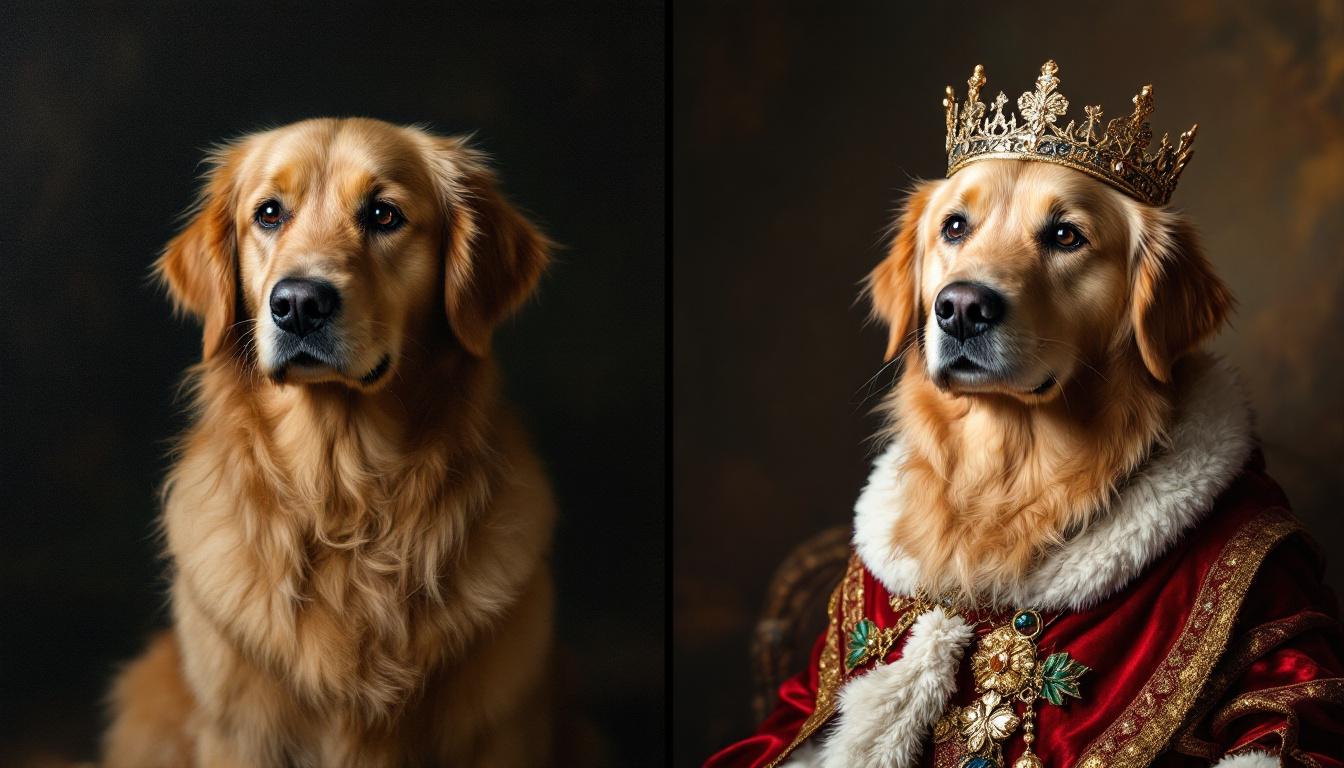
    Side-by-side comparison of traditional oil painting vs AI royal portrait
    Side-by-side comparison of traditional oil painting vs AI royal portrait

    Best Styles for Golden Retrievers

    Not all art styles suit every breed. Golden Retrievers’ warm coloring and expressive faces shine in these styles:

    Royal / Renaissance Portrait

    Think European nobility, velvet robes, ornate frames. This style plays up the Golden’s natural elegance and “gentle giant” vibe.

    Visual effect: Rich jewel tones (burgundy, navy, gold), dramatic lighting, regal posture. Your Golden looks like they’re about to inherit a duchy.

    Best for: Dogs with calm, dignified personalities. Also perfect for memorial portraits — the timeless quality feels respectful and lasting.

    Golden Retriever in royal Renaissance style with velvet robe and crown
    Golden Retriever in royal Renaissance style with velvet robe and crown

    Pixar / Cartoon Style

    Big eyes, exaggerated expressions, vibrant colors. This style captures the goofball side of Golden Retrievers — the personality that makes you laugh every day.

    Visual effect: Soft edges, warm lighting, slightly oversized features. Looks like your dog could star in the next animated movie.

    Best for: Playful, high-energy Goldens. Great for kids’ rooms, Instagram posts, or gifts for people who love your dog’s silly side.

    Golden Retriever in Pixar cartoon style with exaggerated happy expression
    Golden Retriever in Pixar cartoon style with exaggerated happy expression

    Pop Art

    Bold colors, high contrast, Andy Warhol vibes. This style makes your Golden Retriever look like a cultural icon.

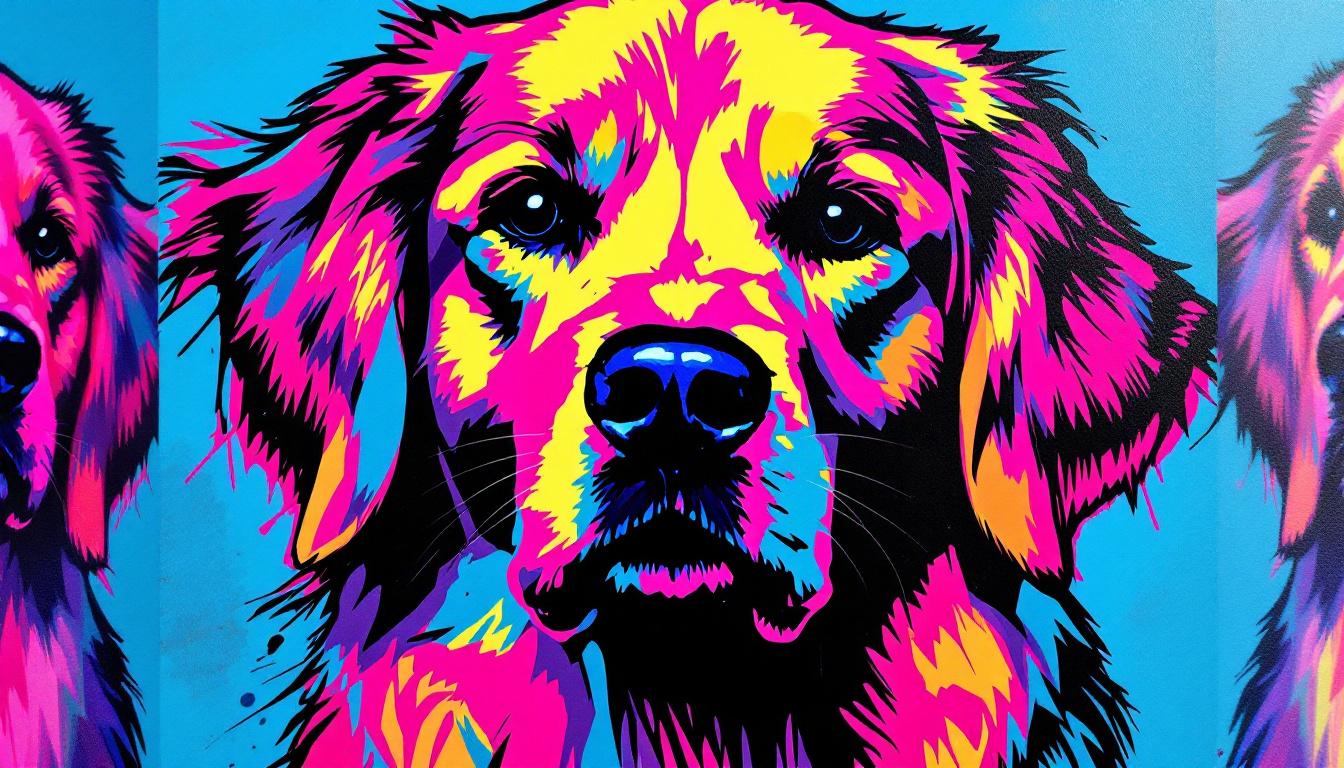
    Visual effect: Neon pinks, electric blues, graphic black outlines. Modern, Instagram-ready, conversation-starter energy.

    Best for: Young, energetic dogs. Perfect for modern homes, gallery walls, or anyone who wants their pet portrait to double as contemporary art.

    Golden Retriever in pop art style with bright neon colors
    Golden Retriever in pop art style with bright neon colors

    Watercolor

    Soft, dreamy, elegant. This style emphasizes the Golden’s gentle nature and flowing fur.

    Visual effect: Pastel tones, blended edges, ethereal quality. Feels peaceful and timeless.

    Best for: Senior dogs, memorial portraits, or anyone who prefers subtle elegance over bold statements. Works beautifully in bedrooms and quiet spaces.

    Golden Retriever in watercolor style with soft pastel tones
    Golden Retriever in watercolor style with soft pastel tones

    How to Get the Best Golden Retriever AI Portrait

    AI is smart, but garbage in = garbage out. Here’s how to set your Golden up for portrait success:

    Photo tips:

  • Good lighting: Natural outdoor light or bright indoor lighting. Avoid harsh shadows across the face.
  • Clear face: Eyes and nose should be in focus. Blurry action shots won’t train the AI properly.
  • Variety: Upload 10-20 photos from different angles — front, side, sitting, standing, close-up, full body. The AI learns your dog’s features better with more data.
  • What works:

  • Post-swim fluff (that iconic Golden “just got out of the lake” look)
  • Tongue-out happy moments
  • Outdoor portraits with natural backgrounds
  • Head tilts and expressive faces
  • What to avoid:

  • Backlit photos (where your dog is a dark silhouette)
  • Too far away (AI needs to see facial features clearly)
  • Busy backgrounds that distract from your dog
  • Motion blur from running or shaking
  • PixPaw-specific tip: The AI trains on your uploaded photos to understand your Golden’s unique features — coat color, face shape, eye expression. More photos = better results. Don’t just upload one “perfect” shot; give it the full personality.

    Golden Retriever Portrait Ideas

    Once you’ve got your AI portraits, what do you do with them?

    Gift ideas:

  • Birthday or adoption anniversary: Print and frame a royal portrait as a celebration gift
  • Christmas: Pop art style makes a fun, modern holiday gift for Golden-obsessed family members
  • New puppy gift: Capture their puppy face in Pixar style before they grow up
  • Memorial portraits:
    If you’ve lost your Golden, a watercolor or royal portrait can honor their memory with dignity. Many owners create a “Rainbow Bridge” gallery wall with their dog’s portrait as the centerpiece. The key is choosing a style that feels respectful — avoid overly playful styles for memorial purposes.

    Home decor:

  • Living room statement piece: Large canvas print in royal or pop art style
  • Gallery wall: Mix multiple styles of the same dog for visual interest
  • Bedroom: Watercolor style for a calming presence
  • Social media:

  • Profile picture (especially pop art or Pixar styles)
  • Instagram highlight covers
  • “Meet my dog” introduction posts
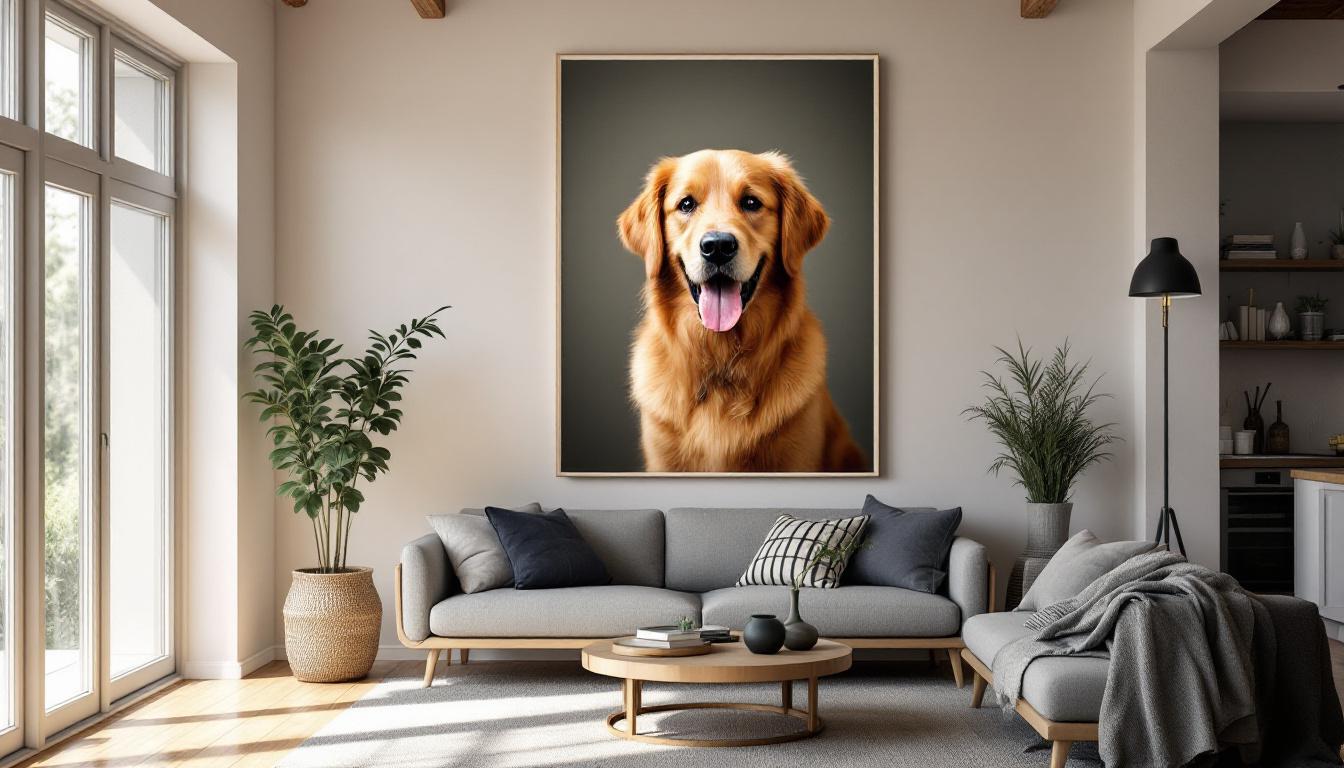
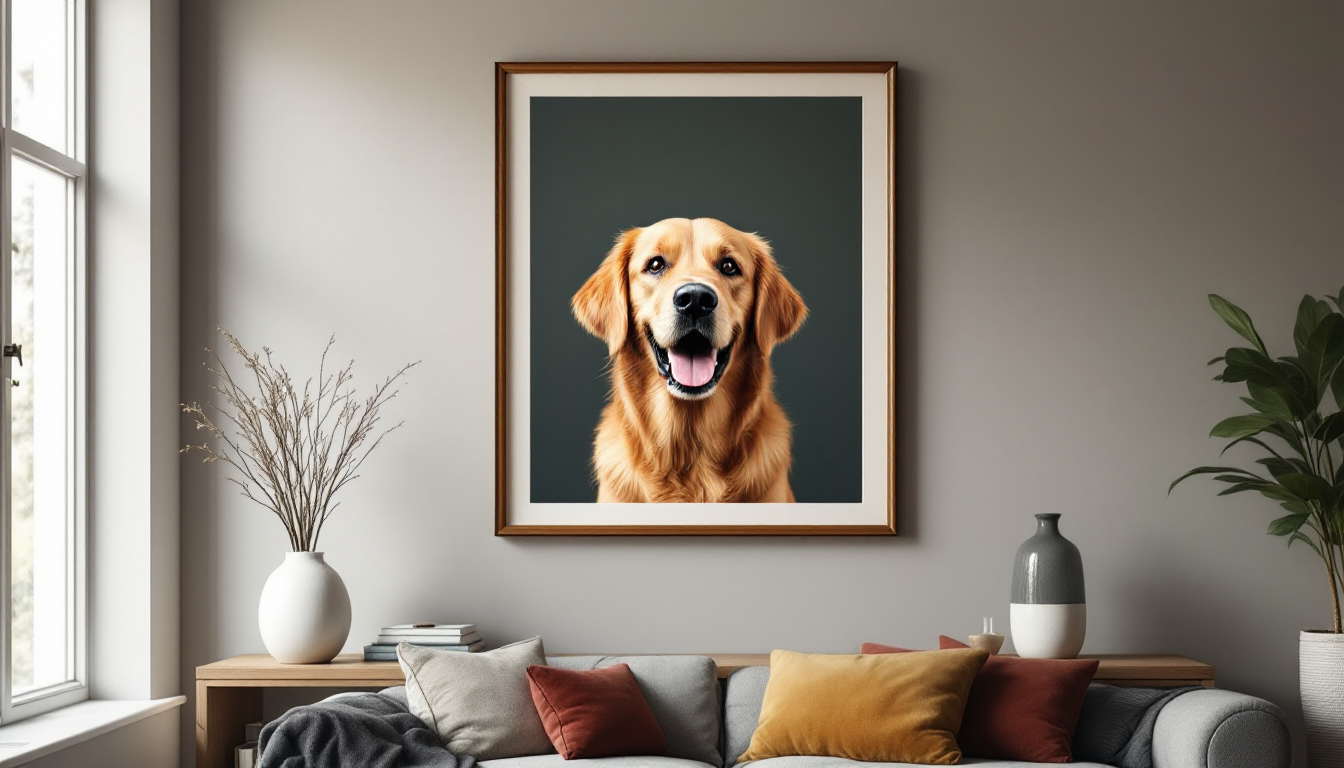
  • Framed Golden Retriever portrait on living room wall
    Framed Golden Retriever portrait on living room wall

    Frequently Asked Questions

    How much does a Golden Retriever AI portrait cost?

    PixPaw AI charges $9.99 for a complete portrait set with multiple styles. You can generate unlimited variations once you’ve uploaded your photos, making it far more affordable than traditional commissioned art ($200-$500+).

    Can I turn my Golden Retriever puppy photo into art?

    Yes. AI portraits work with any age — puppy, adult, or senior. Many owners create a series showing their Golden’s life stages, from fluffy puppy to dignified senior.

    What’s the best art style for a Golden Retriever memorial?

    Watercolor or royal portrait styles work best for memorials. They carry a timeless, respectful quality that honors your dog’s memory without feeling overly playful. Avoid cartoon or pop art styles for memorial purposes.

    Do I need professional photos for AI pet portraits?

    No. Casual iPhone photos work perfectly. The AI trains on 10-20 of your everyday snapshots to learn your Golden’s features. Just make sure faces are clear and well-lit — no need for professional photography.

    How long does it take to generate a Golden Retriever AI portrait?

    PixPaw AI generates portraits in about 30 seconds after you upload your photos. The initial training takes a few minutes, then you can create unlimited style variations instantly.

    Ready to Turn Your Golden’s Smile Into Art?

    Your Golden Retriever’s personality deserves more than a phone gallery. Whether you want a regal royal portrait, a playful Pixar-style masterpiece, or a peaceful watercolor memory, AI makes it possible in seconds.

    PixPaw AI turns any casual photo into professional-quality art for $9.99. No professional photography required. No weeks of waiting. Just upload, choose your style, and watch your Golden transform into a work of art.

    Try PixPaw AI Free →

    Start with your favorite Golden photo and see what’s possible. 30 seconds. $9.99. That smile, immortalized.

  • Golden Retriever AI Portraits: Capturing That Smile

    Golden Retriever AI Portraits: Capturing That Smile

    Golden Retriever AI Portraits: Capturing That Smile

    That goofy, tongue-out, pure-joy Golden Retriever smile — you know the one. It’s in 10,000 photos on your phone, but somehow none of them feel special enough to frame. The lighting’s off, the background’s cluttered, or it just doesn’t capture the personality behind those eyes.

    Now you can turn that everyday snapshot into museum-worthy art. AI portrait generators like PixPaw AI transform casual Golden photos into royal paintings, pop art masterpieces, or watercolor memories — in 30 seconds, for less than the cost of a fancy coffee.

    Why Golden Retrievers Are Perfect Portrait Subjects

    Golden Retrievers are the supermodels of the dog world. Their expressive faces, photogenic golden fur, and natural charisma make them ideal for portraits — whether traditional or AI-generated.

    Unlike black dogs (notoriously hard to photograph due to lighting challenges) or flat-faced breeds (where features can get lost), Goldens have:

    High contrast features: Dark eyes and nose pop against golden fur
    Expressive faces: Every emotion shows — joy, mischief, concern, pure love
    Photogenic fur: Catches light beautifully, works in any art style
    Personality that translates: Their goofy, loving nature shines through in every frame

    The real owner pain point? Too many good photos. You’ve got thousands of Golden pics, but which one deserves to be art? AI portraits solve this — upload 10-20 of your favorites, and the AI learns what makes your dog your dog, then generates portraits that capture their essence across multiple styles.

    Golden Retriever Portrait

    AI vs Traditional Golden Retriever Portraits

    Traditional commissioned portraits have their place — hand-painted oil paintings carry a timeless elegance that AI can’t replicate. But they come with tradeoffs:

    Cost: $200-$500+ depending on artist and size
    Time: 4-6 weeks from commission to delivery
    Photo requirements: Artists need high-resolution, well-lit reference photos (that casual iPhone shot won’t cut it)
    Revisions: Limited or costly

    AI portraits (like PixPaw AI) flip the equation:

    Cost: $9.99 for a full portrait set
    Time: 30 seconds after upload
    Photo requirements: Any casual photo works — the AI trains on multiple images to understand your dog’s features
    Variations: Generate unlimited styles and poses

    When to choose which:

    Traditional: Memorial portraits after loss, heirloom pieces for multi-generational families, when you want a specific artist’s signature style
    AI: Fun gifts, social media content, trying multiple styles before committing to traditional, budget-friendly home decor

    Some owners do both — use AI to explore styles and compositions, then commission a traditional artist to recreate the winning concept.

    Golden Retriever Portrait

    Best Styles for Golden Retrievers

    Not all art styles suit every breed. Golden Retrievers’ warm coloring and expressive faces shine in these styles:

    Royal / Renaissance Portrait

    Think European nobility, velvet robes, ornate frames. This style plays up the Golden’s natural elegance and “gentle giant” vibe.

    Visual effect: Rich jewel tones (burgundy, navy, gold), dramatic lighting, regal posture. Your Golden looks like they’re about to inherit a duchy.

    Best for: Dogs with calm, dignified personalities. Also perfect for memorial portraits — the timeless quality feels respectful and lasting.

    Golden Retriever Portrait

    Pixar / Cartoon Style

    Big eyes, exaggerated expressions, vibrant colors. This style captures the goofball side of Golden Retrievers — the personality that makes you laugh every day.

    Visual effect: Soft edges, warm lighting, slightly oversized features. Looks like your dog could star in the next animated movie.

    Best for: Playful, high-energy Goldens. Great for kids’ rooms, Instagram posts, or gifts for people who love your dog’s silly side.

    Golden Retriever Portrait

    Pop Art

    Bold colors, high contrast, Andy Warhol vibes. This style makes your Golden Retriever look like a cultural icon.

    Visual effect: Neon pinks, electric blues, graphic black outlines. Modern, Instagram-ready, conversation-starter energy.

    Best for: Young, energetic dogs. Perfect for modern homes, gallery walls, or anyone who wants their pet portrait to double as contemporary art.

    Golden Retriever Portrait

    Watercolor

    Soft, dreamy, elegant. This style emphasizes the Golden’s gentle nature and flowing fur.

    Visual effect: Pastel tones, blended edges, ethereal quality. Feels peaceful and timeless.

    Best for: Senior dogs, memorial portraits, or anyone who prefers subtle elegance over bold statements. Works beautifully in bedrooms and quiet spaces.

    Golden Retriever Portrait

    How to Get the Best Golden Retriever AI Portrait

    AI is smart, but garbage in = garbage out. Here’s how to set your Golden up for portrait success:

    Photo tips:
    Good lighting: Natural outdoor light or bright indoor lighting. Avoid harsh shadows across the face.
    Clear face: Eyes and nose should be in focus. Blurry action shots won’t train the AI properly.
    Variety: Upload 10-20 photos from different angles — front, side, sitting, standing, close-up, full body. The AI learns your dog’s features better with more data.

    What works:
    – Post-swim fluff (that iconic Golden “just got out of the lake” look)
    – Tongue-out happy moments
    – Outdoor portraits with natural backgrounds
    – Head tilts and expressive faces

    What to avoid:
    – Backlit photos (where your dog is a dark silhouette)
    – Too far away (AI needs to see facial features clearly)
    – Busy backgrounds that distract from your dog
    – Motion blur from running or shaking

    PixPaw-specific tip: The AI trains on your uploaded photos to understand your Golden’s unique features — coat color, face shape, eye expression. More photos = better results. Don’t just upload one “perfect” shot; give it the full personality.

    Golden Retriever Portrait Ideas

    Once you’ve got your AI portraits, what do you do with them?

    Gift ideas:
    Birthday or adoption anniversary: Print and frame a royal portrait as a celebration gift
    Christmas: Pop art style makes a fun, modern holiday gift for Golden-obsessed family members
    New puppy gift: Capture their puppy face in Pixar style before they grow up

    Memorial portraits:
    If you’ve lost your Golden, a watercolor or royal portrait can honor their memory with dignity. Many owners create a “Rainbow Bridge” gallery wall with their dog’s portrait as the centerpiece. The key is choosing a style that feels respectful — avoid overly playful styles for memorial purposes.

    Home decor:
    Living room statement piece: Large canvas print in royal or pop art style
    Gallery wall: Mix multiple styles of the same dog for visual interest
    Bedroom: Watercolor style for a calming presence

    Social media:
    – Profile picture (especially pop art or Pixar styles)
    – Instagram highlight covers
    – “Meet my dog” introduction posts

    Golden Retriever Portrait

    Frequently Asked Questions

    How much does a Golden Retriever AI portrait cost?

    PixPaw AI charges $9.99 for a complete portrait set with multiple styles. You can generate unlimited variations once you’ve uploaded your photos, making it far more affordable than traditional commissioned art ($200-$500+).

    Can I turn my Golden Retriever puppy photo into art?

    Yes. AI portraits work with any age — puppy, adult, or senior. Many owners create a series showing their Golden’s life stages, from fluffy puppy to dignified senior.

    What’s the best art style for a Golden Retriever memorial?

    Watercolor or royal portrait styles work best for memorials. They carry a timeless, respectful quality that honors your dog’s memory without feeling overly playful. Avoid cartoon or pop art styles for memorial purposes.

    Do I need professional photos for AI pet portraits?

    No. Casual iPhone photos work perfectly. The AI trains on 10-20 of your everyday snapshots to learn your Golden’s features. Just make sure faces are clear and well-lit — no need for professional photography.

    How long does it take to generate a Golden Retriever AI portrait?

    PixPaw AI generates portraits in about 30 seconds after you upload your photos. The initial training takes a few minutes, then you can create unlimited style variations instantly.

    Ready to Turn Your Golden’s Smile Into Art?

    Your Golden Retriever’s personality deserves more than a phone gallery. Whether you want a regal royal portrait, a playful Pixar-style masterpiece, or a peaceful watercolor memory, AI makes it possible in seconds.

    PixPaw AI turns any casual photo into professional-quality art for $9.99. No professional photography required. No weeks of waiting. Just upload, choose your style, and watch your Golden transform into a work of art.

    Try PixPaw AI Free →

    Start with your favorite Golden photo and see what’s possible. 30 seconds. $9.99. That smile, immortalized.

  • 15 Heartfelt Pet Memorial Gift Ideas to Honor Your Beloved Companion (2026)

    15 Heartfelt Pet Memorial Gift Ideas to Honor Your Beloved Companion (2026)

    15 Heartfelt Pet Memorial Gift Ideas to Honor Your Beloved Companion (2026)

    We understand losing a pet is one of life’s most profound heartbreaks. The silence in your home feels deafening. The empty spot on the couch seems to grow larger each day. And that collar, still hanging by the door, becomes a reminder of paws that will never pad through your hallway again.

    Our pets aren’t just animals we care for—they’re family members who witness our best and worst moments without judgment. They celebrate our joys with uninhibited enthusiasm and comfort our sorrows with quiet, steadfast presence. When they leave us, the grief is real, valid, and often misunderstood by those who haven’t experienced that unique bond.

    If you’re searching for pet memorial gift ideas for yourself or someone you love, know this: there is no “getting over” the loss of a beloved companion. But there are ways to carry their memory forward—tangible reminders of love that doesn’t end simply because physical presence has. The right memorial gift doesn’t fix grief; it honors it, creating space for healing while keeping precious memories alive.

    In 2026, memorial options have evolved far beyond traditional urns and generic plaques. From cutting-edge AI technology to handcrafted artisan pieces, today’s pet memorial gifts offer deeply personal ways to celebrate the unique spirit of every companion. This guide presents fifteen thoughtful ideas, each chosen for its ability to provide genuine comfort during an impossibly difficult time.

    1. AI Memorial Portrait by PixPawAI

    Pet Memorial Gift 1

    When grief is fresh, waiting months for a commissioned portrait feels unbearable. AI memorial portraits offer a revolutionary solution—transforming your favorite pet photos into stunning artistic masterpieces within hours, not weeks.

    PixPawAI specializes in creating these deeply personal tributes, understanding that memorial portraits serve a purpose beyond decoration. They become focal points for remembrance, conversation starters for sharing memories, and daily reminders that love transcends physical presence.

    The technology works remarkably well even with imperfect photos—the casual snapshot from your phone, the slightly blurry picture of them mid-wag, or that one photo where their personality shone through despite poor lighting. AI can enhance, restore, and reimagine these images into gallery-worthy artwork.

    Multiple artistic styles allow you to capture your pet’s essence authentically. Choose classical Renaissance-inspired treatments for dignified, timeless portraits. Select watercolor effects for gentle, dreamlike memorials. Opt for modern artistic interpretations that reflect your pet’s vibrant personality. Each style transforms a familiar photograph into something extraordinary—a piece of art worthy of the love you shared.

    Unlike traditional commissioned portraits that can cost hundreds of dollars and require extensive back-and-forth with artists, AI memorial portraits are accessible, affordable, and immediate. This matters when you’re grieving and need something beautiful now, not months from now.

    These portraits work beautifully as canvas prints for prominent wall display, framed desk photos for office spaces, or digital versions shared with family members who also loved your pet. Many pet parents create multiple versions—one for home, one for the office, digital copies for children who’ve moved away.

    Create your custom AI pet memorial portrait with PixPawAI →

    2. Custom Rainbow Bridge Art

    Pet Memorial Gift 2

    The Rainbow Bridge story has comforted grieving pet parents for generations. This beautiful legend describes a meadow where departed pets wait, healthy and happy, until they can reunite with their owners. Custom Rainbow Bridge art brings this comforting imagery to life with your specific pet as the subject.

    Artists create personalized pieces showing your pet—recognizable by breed, coloring, and distinctive markings—peacefully resting or playing in this mythical paradise. Some compositions include their favorite toys, the landscapes they loved, or symbolic elements representing their personality.

    These pieces serve dual purposes: they acknowledge the painful reality of loss while offering hope through spiritual comfort. For many pet parents, Rainbow Bridge art becomes the centerpiece of a memorial display, surrounded by candles, photos, and small keepsakes.

    Options range from watercolor paintings with soft, ethereal qualities to detailed digital illustrations, from simple line drawings to elaborate fantasy landscapes. Consider your pet’s personality when selecting a style—a playful, energetic dog might suit a dynamic composition showing them running through meadows, while a serene, contemplative cat might be best captured in peaceful repose.

    The best Rainbow Bridge pieces capture not just your pet’s appearance but their spirit—that unique combination of characteristics that made them irreplaceable.

    3. Paw Print Keepsake
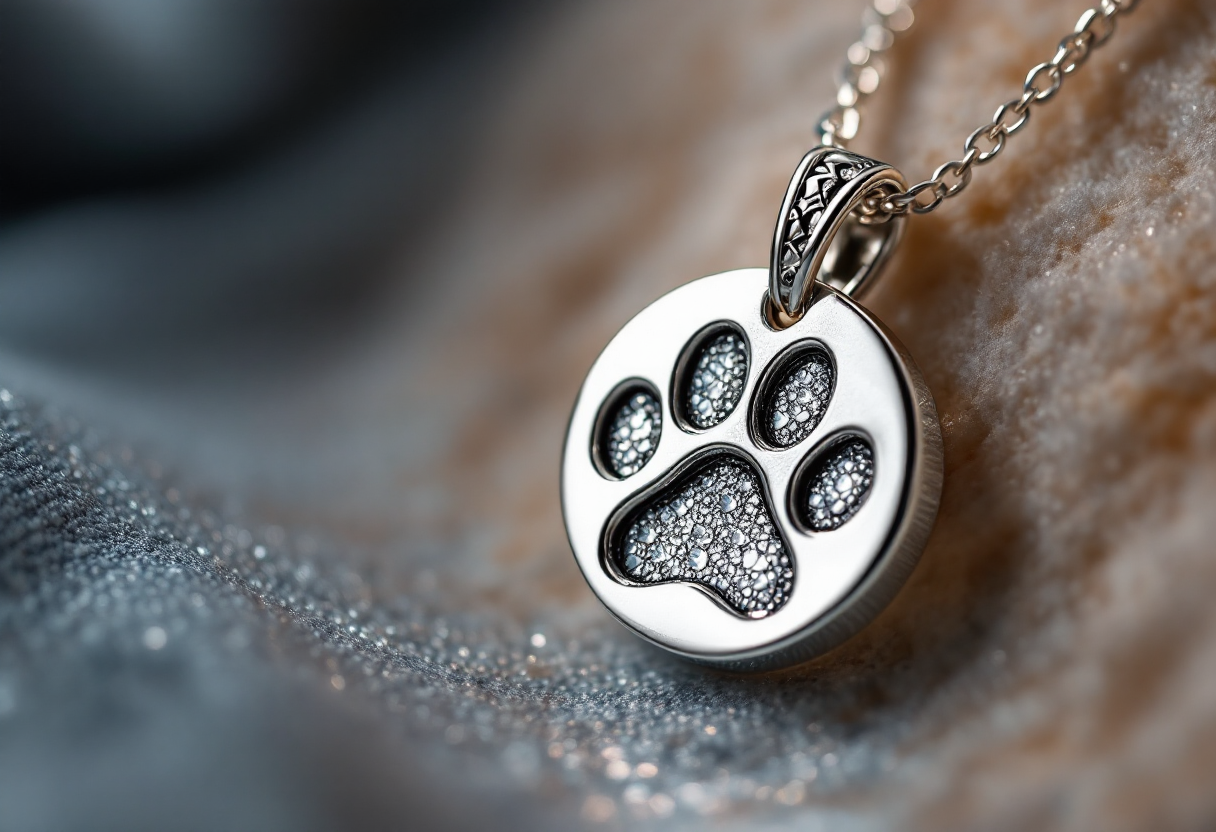
    Pet Memorial Gift 3

    There’s something profoundly moving about holding an exact replica of the paw that once padded beside you, the paw that tapped your leg asking for attention, the paw that rested trustingly in your hand. Paw print keepsakes transform these physical traces into permanent memorials.

    Several approaches exist, each offering different emotional resonance. Clay impressions capture texture and depth—you can feel the individual pads, the tiny lines and grooves that made your pet’s paw uniquely theirs. These can be kiln-fired for permanence, creating ceramic pieces that last generations.

    Metal castings take paw prints to another level of permanence. Many veterinary clinics now offer services to capture your pet’s paw print in materials suitable for casting into silver, gold, or bronze jewelry and art pieces. The resulting keepsakes carry the exact impression—the weight, the texture, the precise dimensions—of your companion’s touch.

    For pets still living, ink prints on archival paper provide simple, beautiful records. For those already passed, many owners find comfort in taking prints from clay impressions made during euthanasia appointments—a difficult moment that yields precious mementos.

    Paw print keepsakes work as standalone art pieces, jewelry components, integrated elements in larger memorial displays, or touchstones kept in pockets and purses for moments when you need to feel close to your pet.

    4. Memorial Jewelry
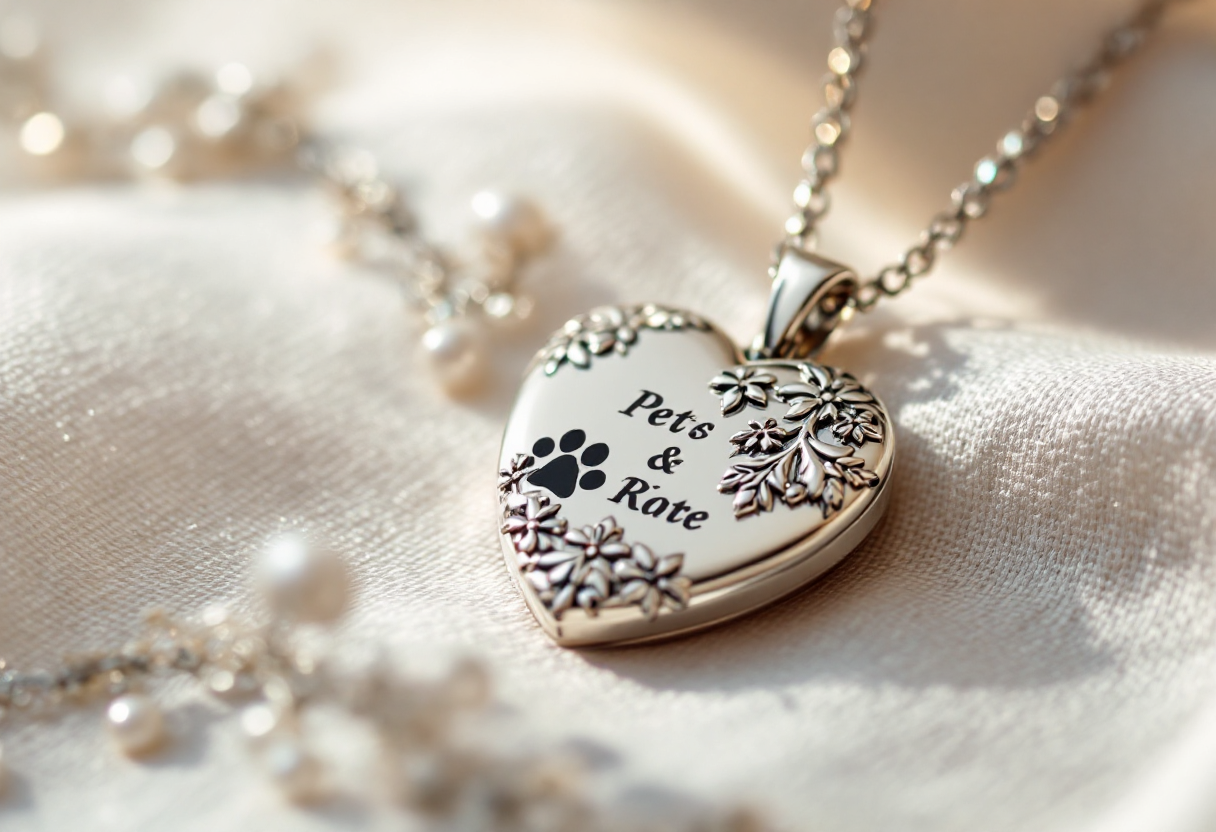
    Pet Memorial Gift 4

    Wearing your pet’s memory close to your heart—literally—provides subtle, constant comfort throughout the day. Memorial jewelry has evolved far beyond simple lockets into sophisticated pieces that honor pets with genuine artistry.

    Portrait jewelry features hand-painted miniatures of your pet’s face, rendered by artists who specialize in capturing animal expressions on tiny canvases. These pieces become family heirlooms, passed down with stories of beloved companions.

    Cremation jewelry incorporates small portions of ashes into pendants, rings, or bracelets. Modern designs have moved beyond obvious “urn jewelry” to pieces that look like contemporary accessories while carrying profound personal significance. Glassblowers can swirl ashes into beautiful beads; jewelers can incorporate them into metalwork.

    Fingerprint and nose print jewelry captures another unique identifier—the patterns on your pet’s nose are as distinctive as human fingerprints. Cast in precious metals, these become abstract yet deeply personal memorial pieces.

    For those who prefer subtlety, many memorial jewelry options appear as ordinary accessories to outside observers. Only the wearer knows that pendant contains ashes, that bracelet charm captures a nose print, that ring engraving marks important dates. This discretion allows comfort without forcing conversations when you’re not ready to have them.

    When selecting memorial jewelry, consider durability and daily wear. Pieces you can wear constantly provide ongoing comfort; those requiring special care may spend more time in boxes than providing solace.

    5. Memorial Photo Book

    Pet Memorial Gift 5

    In an age of digital photos scattered across devices, there’s profound power in curated, printed collections. A memorial photo book transforms hundreds of casual snapshots into a narrative arc—the story of a life well-lived, well-loved, and never forgotten.

    The creation process itself becomes part of healing. Reviewing years of photos, you’ll laugh at forgotten moments, notice patterns you never recognized before, and remember the full spectrum of your life together. That couch they destroyed as a puppy becomes funny in retrospect. The graying muzzle photos that once made you sad now show the dignity of age.

    Effective memorial photo books tell stories chronologically—from adoption through adventures, from silly moments to quiet companionship. But they can also follow themes: “Our Hiking Buddy” documenting trail adventures, “Couch Potato Chronicles” celebrating lazy Sundays, “The Many Faces of [Pet’s Name]” capturing personality through expression.

    Many services now offer pet-specific templates designed for memorial purposes, with appropriate layouts, quote suggestions, and design elements. But custom creations often feel more personal—hand-selected backgrounds, personally written captions, deliberate sequencing that builds emotional narrative.

    Consider including text elements beyond simple captions: stories behind the photos, quotes that resonated during your time together, letters written to your pet expressing everything you want them to know. These words become part of the legacy, preserving not just images but the emotional truth of your bond.

    6. Memorial Garden Stone

    Pet Memorial Gift 6

    For those who find peace in nature and gardening, a memorial garden stone creates a dedicated space for remembrance that evolves with the seasons. Unlike indoor memorials that remain static, garden memorials grow, change, and respond to weather—much like grief itself.

    Natural stones—river rocks, field stones, slate—can be professionally engraved with names, dates, quotes, or paw prints. These blend organically into garden landscapes, weathering naturally over time and becoming part of the environment rather than obvious additions to it.

    Cast concrete markers offer more design flexibility, with options for embedded photos, ceramic tiles, mosaic elements, or sculpted details. These can be customized to reflect your pet’s personality—a dog who loved water might have a stone placed near a water feature; a sun-loving cat might be remembered with a marker in the sunniest garden spot.

    Consider the garden stone’s placement carefully. Some pet parents create dedicated memorial gardens with benches for sitting, bird feeders to attract wildlife, and plants that bloom in seasons significant to their pet. Others integrate markers into existing landscapes where they naturally encounter them during daily routines.

    Solar-powered illuminated stones provide gentle evening glow, creating nighttime memorial spaces. Wind chimes hung nearby add auditory elements that trigger memory and presence. The combination of visual, tactile, and environmental elements makes garden memorials uniquely immersive experiences.

    7. Donation in Your Pet’s Name

    Pet Memorial Gift 7

    For pet parents who find meaning in helping others, a donation in your pet’s name transforms personal loss into community good. This approach creates living legacies where grief generates positive impact for animals still waiting for homes.

    Local animal shelters and rescue organizations often maintain memorial donation programs. Your contribution might fund medical care for injured rescues, provide food and supplies for foster animals, or support adoption events that match pets with new families. Many organizations provide acknowledgment cards or certificates suitable for framing alongside your pet’s photo.

    Veterinary schools conducting research into pet diseases offer another meaningful option. If your pet suffered from a specific condition, supporting research toward treatment or cure honors their struggle while helping future animals.

    Organizations providing service animals to people with disabilities create powerful ripple effects from memorial donations. Your pet’s legacy helps train dogs who will transform human lives—an extension of the unconditional love your pet gave you.

    For nature-loving pet owners, wildlife conservation groups offer fitting memorials. Protecting the wild cousins of our domestic companions extends care beyond individual animals to entire species and ecosystems.

    The key is selecting organizations aligned with your pet’s personality and your values. A dog who loved meeting new people might be honored through therapy animal programs. A cat rescued from difficult circumstances might inspire donations to organizations fighting animal cruelty.

    8. Memory Box

    Pet Memorial Gift 8

    Grief rarely follows predictable patterns. Some days you want to surround yourself with memories; other days, seeing reminders feels overwhelming. A memory box provides flexibility—keeping precious items protected and organized while allowing you to engage with them on your own terms.

    Unlike scattered mementos that can trigger unexpected emotional responses, a dedicated memory box creates boundaries around grief objects. You know exactly where everything is. You control when and how you access these items. The box itself becomes a ritual object—the act of opening it signifies intentional remembrance.

    Quality memory boxes designed specifically for pet memorials include compartments for different item types: spaces for collars and tags, velvet-lined sections for jewelry, photo sleeves, and drawers for small toys or treats. Some include built-in frames for displaying photos while storing other items.

    Personalization transforms simple boxes into meaningful memorials. Laser engraving can include names, dates, quotes, or paw prints. Wood selection might reference your pet—oak for strength, cherry for warmth, maple for sweetness. Interior fabrics can match your pet’s coloring or favorite blanket textures.

    Consider including not just physical objects but written memories: printed photos with stories on the back, letters to your pet expressing everything you wish you could say, cards from veterinarians or friends who understood your loss. These words become part of the keepsake collection, preserving emotional context alongside physical traces.

    9. Custom Memorial Pillow

    Pet Memorial Gift 9

    There’s something instinctively comforting about holding something soft when grieving. Custom memorial pillows combine this tactile comfort with visual reminders of your pet, creating hug-able memorials for moments when you need to feel close.

    Photo pillows print your favorite images directly onto soft fabrics. High-quality options use dye-sublimation processes that embed images into material fibers rather than sitting on top, creating durable prints that won’t crack or fade with washing and hugging.

    Memory pillows take this concept further by incorporating actual materials from your pet’s life. Some artisans create pillows using fabric from your pet’s favorite blanket, bed, or even clothing items that carried their scent. These carry olfactory memories as well as visual ones—though scent eventually fades, the association remains powerful.

    Silhouette pillows feature your pet’s profile cut from fabric and appliquéd onto complementary backgrounds. These abstract representations can feel less emotionally overwhelming than photo-realistic images while still capturing recognizable form.

    Shape-cut pillows molded into your pet’s silhouette offer another variation—cuddly representations you can hold that approximate your pet’s size and sleeping positions. These particularly comfort children processing pet loss, providing transitional objects that help them navigate grief.

    Consider placement when selecting memorial pillows. Bedside pillows provide comfort during difficult nights. Couch pillows integrate into daily life spaces. Travel-sized versions allow you to carry comfort during trips when grief might surprise you away from home.

    10. Engraved Memorial Frame

    Pet Memorial Gift 10

    Sometimes the simplest memorials carry the most weight. An engraved memorial frame elevates a favorite photograph into a permanent tribute through quality materials and personalized details.

    Wood frames offer warmth and natural beauty, with engraving options that include names, dates, quotes, and decorative elements like paw prints, hearts, or angel wings. Different wood species carry different energies—dark walnut feels dignified and formal, light maple feels fresh and hopeful, reclaimed barn wood carries rustic character.

    Metal frames provide contemporary alternatives with clean lines and durability. Aluminum, brass, or stainless steel can be etched or engraved with fine detail, creating modern memorials suited to contemporary decor.

    Shadow box frames add dimension by creating space between glass and backing, allowing inclusion of three-dimensional mementos alongside photos: collars, tags, small toys, tufts of fur. These become miniature memorial displays within single frames.

    Multi-photo frames tell more complete stories, showing your pet at different ages, in various activities, with family members they loved. These chronological displays capture the fullness of a life rather than single moments.

    When selecting frames, consider where they’ll live. Prominent placement on mantels or walls keeps memories visible and present. Desk frames provide workplace comfort. Bedroom placement creates intimate remembrance spaces. The right location depends on your grieving process—some need constant visibility; others prefer selective engagement.

    11. Memorial Candle

    Pet Memorial Gift 11

    Across cultures and throughout history, candle-lighting rituals honor the deceased and create space for reflection. Memorial candles designed specifically for pets adapt these ancient practices for modern grieving, providing focal points for intentional remembrance.

    Custom labels transform ordinary candles into personalized memorials. Your pet’s photo, name, and important dates printed on quality labels create objects worthy of permanent display even after the wax burns away. Many companies offer refillable containers, allowing the memorial vessel to remain while candles are replaced.

    Scent selection adds another dimension of personalization. Lavender promotes calm and sleep—helpful when grief disrupts rest. Vanilla provides comfort and warmth. Some companies offer custom scent blending, allowing you to create fragrances associated with your pet—grass and earth for outdoor lovers, clean cotton for pets who loved fresh laundry, woodsy notes for nature companions.

    Soy and beeswax options appeal to environmentally conscious pet parents, burning cleaner than petroleum-based paraffin while supporting sustainable practices your pet would have appreciated during life.

    The ritual of lighting a memorial candle creates structured opportunities for grief. Many pet parents light candles on anniversaries of adoption or passing, on birthdays, during holidays when absence feels acute, or whenever missing their companion becomes overwhelming. This small ceremony acknowledges pain while containing it within manageable boundaries.

    LED candles offer alternatives for situations where open flames aren’t practical—dorm rooms, hospital stays, households with small children. Modern versions flicker realistically and can be set on timers, providing automated evening memorial rituals.

    12. Pet Loss Book

    Pet Memorial Gift 12

    Grief can feel isolating, especially when society doesn’t fully acknowledge the depth of pet loss. Pet loss books provide companionship through words, offering validation, guidance, and the comfort of knowing others have walked this path before.

    Memoirs by writers who’ve experienced profound pet loss remind us we’re not alone in our devastation. These personal stories capture the specific quality of pet-human relationships and the particular character of pet grief. Reading about others’ journeys helps normalize our own intense reactions.

    Guided grief workbooks provide structured approaches to processing loss. Writing prompts encourage exploration of memories, unexpressed emotions, and complicated feelings like guilt or relief. These active approaches can complement passive grieving, giving direction when grief feels overwhelming.

    Children’s books about pet loss help younger family members navigate emotions they lack vocabulary to express. These age-appropriate resources address concepts like death, afterlife beliefs (including Rainbow Bridge), and continuing bonds with deceased pets. Sharing these books creates opportunities for family conversations about loss.

    Spiritual and philosophical texts explore deeper questions raised by pet mortality: Do animals have souls? Will we be reunited? What do our relationships with pets teach us about love and impermanence? These explorations provide comfort for those wrestling with existential aspects of grief.

    When selecting pet loss books for others, consider their processing style. Some people want practical coping strategies; others seek emotional validation; still others need spiritual comfort. The right book meets them where they are rather than where you think they should be.

    13. Sympathy Card (with Personal Touch)

    Pet Memorial Gift 13

    Never underestimate the power of a thoughtful sympathy card. In an age of digital communication, physical cards carrying handwriting feel precious and deliberate. They become keepsakes themselves, saved and reread during difficult moments.

    The best pet sympathy cards acknowledge the specific relationship between human and animal rather than offering generic condolences. They recognize that this wasn’t “just a pet” but a family member, a daily companion, a source of unconditional love that cannot be replaced.

    Personalization elevates cards from polite gestures to meaningful memorial contributions. Include a specific memory of the pet—”I’ll never forget how Max would greet everyone at the door with his stuffed duck”—demonstrating that you noticed and valued their unique personality.

    Pressed flowers from your own garden add organic beauty and the implicit message that life continues in new forms. Small photos you’ve taken of their pet show you documented their relationship too. These physical additions transform cards into memory objects worth keeping.

    What you write matters more than card design. Avoid minimizing phrases like “at least they lived a long life” or “you can get another one.” Instead, validate their grief: “I’m heartbroken for you. Max was such a special dog, and I know how much you loved each other.” Offer specific support: “I’m bringing dinner Tuesday” rather than “Let me know if you need anything.”

    Consider timing. Cards arriving immediately after loss provide immediate comfort, but cards sent weeks or months later—when most support has withdrawn—often mean even more. Grief doesn’t end after the funeral, and late acknowledgment recognizes ongoing mourning.

    14. Memorial Ornament

    Pet Memorial Gift 14

    Holidays often amplify grief. The empty spot where your pet once begged for turkey, the absent presence during gift-opening, the changed rhythms of celebration all highlight loss. Memorial ornaments integrate remembrance into holiday traditions, acknowledging that our companions remain part of family celebrations even after death.

    Photo ornaments preserve favorite images in durable materials designed for annual display. Glass, metal, and acrylic options each offer different aesthetics—vintage warmth, contemporary shine, or modern minimalism. Many feature space for engraved names and dates.

    Paw print ornaments capture physical traces in decorative form. Clay impressions, metal castings, or glasswork incorporating actual prints create tangible connections to touch and presence.

    Angel-themed ornaments incorporate imagery of pets as guardian spirits watching over families. Feathers, halos, and wing motifs provide visual language for hopes of continued connection.

    Some families create new traditions around memorial ornaments: hanging them first each year while sharing favorite memories, placing them on special stands when trees come down, or including them in holiday cards to distant family who also grieve the loss.

    While Christmas ornaments are most common, consider ornaments for other holidays if they held significance for your pet. A Hanukkah decoration, a Halloween piece for pets who loved greeting trick-or-treaters, or a birthday ornament for their adoption anniversary keeps memory present throughout the year.

    15. Custom Memorial Blanket
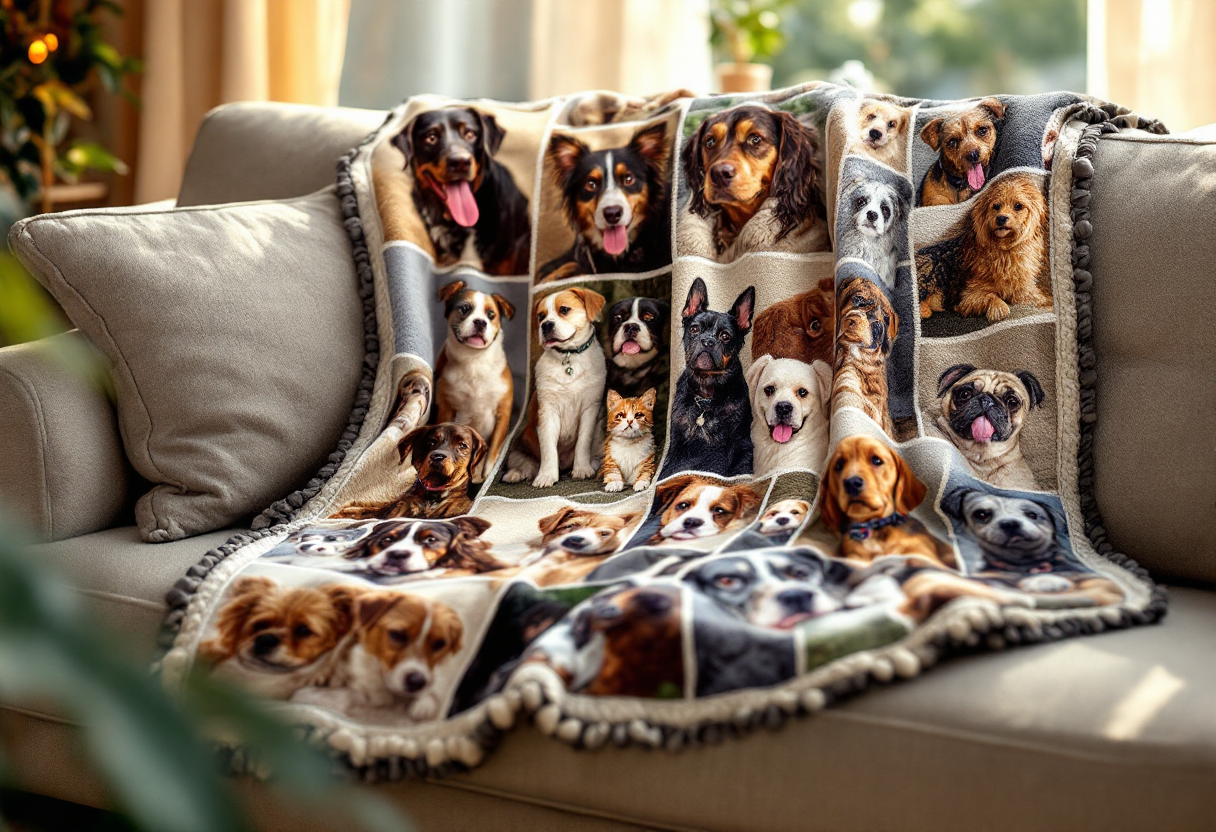
    Pet Memorial Gift 15

    Wrapping yourself in memory provides physical comfort during emotional storms. Custom memorial blankets transform favorite photos into soft, enveloping tributes that provide warmth both literal and metaphorical.

    Woven photo blankets offer durability and classic style. These use jacquard weaving techniques to translate photographs into textile form, creating pieces that improve with age and washing. The woven texture adds depth and richness beyond simple printed images.

    Fleece and sherpa blankets maximize softness for moments when you need to cocoon in grief. These plush materials provide sensory comfort—the kind of soft texture many pets themselves appreciated. Wrapping up in something soft honors the instinctive comfort-seeking behaviors our pets taught us.

    Photo collage blankets allow multiple images, creating comprehensive visual narratives of your pet’s life. These work particularly well for pets who lived long, full lives with many documented adventures.

    Some companies offer quilt-style blankets that incorporate fabric from your pet’s belongings—their favorite blanket, bed, or your clothing that carries their scent. These memory quilts become patchwork stories, each square holding different associations and moments.

    Consider size carefully. Throw blankets work for couch cuddling and lap coverage during difficult phone calls or television watching. Full-size blankets provide bed coverage for nights when sleeping alone feels hardest. Travel sizes allow comfort during car trips, hospital visits, or anywhere grief might surprise you.

    Creating Your Memorial: A Final Thought

    Grief has no timeline, no roadmap, no “right” way to process. Some pet parents create elaborate memorials immediately; others need months before they can engage with remembrance objects. Some prefer private, intimate memorials; others find healing in shared, public tributes. Your path is your own, and all responses to loss are valid.

    The memorial gifts listed here share common qualities: they acknowledge that your pet mattered, they create tangible connections to memory, and they provide comfort without demanding that you “move on” or “get over it.” The best memorial for your situation depends on your personality, your grieving style, your relationship with your pet, and your current emotional needs.

    Many pet parents find that combining multiple memorial types creates the most meaningful tributes. An AI portrait displayed above a memory box containing collars and tags. A garden stone near a wind chime that rings with passing breezes. A photo book opened to favorite pages beside a memorial candle. These integrated memorial spaces become sacred places for processing grief and celebrating love.

    Whatever you choose, know that wanting to memorialize your pet is itself an act of love. The impulse to remember, to honor, to keep connection alive—these demonstrate the profound impact your pet had on your life. Death ends a life, but it cannot end a relationship. The love you shared continues in memory, in stories, and in the memorials you create.

    If you’re looking for a unique way to capture your pet’s spirit in beautiful artwork, PixPawAI creates custom AI-generated memorial portraits that transform your favorite photos into timeless pieces of art. With multiple artistic styles, quick turnaround times, and affordable pricing, it’s a meaningful way to create a lasting tribute to the companion who changed your life.

    Have you found a particularly meaningful way to remember a beloved pet? Every grief journey is unique, but sharing our stories helps others find their own path to healing. The love we share with our pets doesn’t end—it simply takes new forms, living on in memory, in art, and in the ways we honor their presence in our lives.


  • Best AI Pet Portrait Generators in 2026: PixPawAI vs Pawcaso vs DreamPets Compared

    Best AI Pet Portrait Generators in 2026: PixPawAI vs Pawcaso vs DreamPets Compared

    # Best AI Pet Portrait Generators in 2026: PixPawAI vs Pawcaso vs DreamPets Compared

    ## Quick Answer
    **PixPawAI stands out as the best AI pet portrait generator in 2026** for its diverse artistic styles, affordable one-time pricing, and extensive physical product options. While Pawcaso offers strong artistic quality and DreamPets provides good value, PixPawAI’s combination of creative flexibility, reasonable pricing ($4.99 for 15 credits), and professional-grade outputs makes it the top choice for pet owners seeking high-quality AI portraits.

    ## Feature Comparison

    | Feature | PixPawAI | Pawcaso | DreamPets |
    |———|———-|———|———–|
    | **Free Tier** | 1-2 credits (watermarked) | Free tier available | Limited free trial |
    | **Pricing** | $4.99/15 credits, $19.99/50, $39.99/200 (one-time) | Starting from $9.99/month | Starting from $6.99/month |
    | **Art Styles** | 15+ styles (Royal, Fashion Editorial, Wes Anderson, etc.) | 10+ artistic styles | 8+ preset styles |
    | **Physical Products** | Canvas, mug, pillow, phone case, t-shirt | Canvas prints available | Limited print options |
    | **Custom Prompts** | Full support | Limited customization | Basic prompts only |
    | **Quality** | Professional-grade 4K output | High-quality artistic renders | Good quality standard output |

    ## PixPawAI: Comprehensive Review

    PixPawAI emerges as the most versatile AI pet portrait generator available in 2026, offering an impressive range of artistic styles that cater to diverse aesthetic preferences. The platform’s standout feature is its extensive style library, including Royal portraits that transform pets into regal figures, Fashion Editorial looks for modern appeal, seasonal themes like Christmas and Birthday celebrations, and unique artistic interpretations such as Wes Anderson’s distinctive cinematographic style and intricate Embroidery Art designs.

    **Pros:**
    – **Diverse Style Portfolio**: Over 15 unique artistic styles ranging from classical Royal portraits to contemporary Magazine Chic aesthetics
    – **Affordable One-Time Pricing**: No subscription model; pay-per-use starting at $4.99 for 15 credits
    – **Extensive Physical Product Line**: Transform digital portraits into tangible keepsakes including canvas prints, mugs, pillows, phone cases, and t-shirts
    – **Custom Prompt Support**: Advanced users can input specific creative directions for personalized results
    – **Professional Quality**: 4K resolution outputs suitable for large format printing

    **Cons:**
    – Free tier includes watermarks, requiring paid credits for clean outputs
    – Learning curve for maximizing custom prompt effectiveness

    **Best For**: Pet owners seeking artistic variety, professional-quality outputs, and physical merchandise options without ongoing subscription commitments.

    ## Pawcaso: Artistic Focus Review

    Pawcaso positions itself as the artist-centric AI pet portrait generator, emphasizing painterly aesthetics and classical art styles. The platform excels in creating portraits that mimic traditional painting techniques, making it particularly appealing to users who prefer fine art interpretations of their pets.

    **Pros:**
    – **Artistic Excellence**: Strong focus on painterly styles and classical art techniques
    – **Quality Consistency**: Reliable output quality across different pet breeds and poses
    – **Canvas Print Integration**: Seamless ordering process for high-quality canvas prints

    **Cons:**
    – **Subscription Model**: Monthly recurring costs starting from $9.99
    – **Limited Style Variety**: Fewer contemporary and themed style options compared to competitors
    – **Restricted Customization**: Limited ability to input custom creative directions

    **Best For**: Art enthusiasts who prioritize classical painting aesthetics and don’t mind subscription-based pricing for consistent artistic quality.

    ## DreamPets: Budget-Friendly Review

    DreamPets targets budget-conscious pet owners with competitive pricing and straightforward functionality. While it may not offer the extensive customization of premium alternatives, it delivers solid results for users seeking affordable AI pet portraits.

    **Pros:**
    – **Competitive Pricing**: Starting at $6.99/month, making it accessible for regular use
    – **User-Friendly Interface**: Simple, intuitive design suitable for beginners
    – **Quick Processing**: Fast turnaround times for portrait generation

    **Cons:**
    – **Limited Style Options**: Only 8 preset styles available, restricting creative choices
    – **Basic Customization**: Minimal prompt customization capabilities
    – **Fewer Physical Products**: Limited merchandise options compared to competitors

    **Best For**: Budget-conscious users who prioritize affordability and simplicity over extensive customization options.

    ## Frequently Asked Questions

    ### What is the best AI pet portrait generator?

    PixPawAI is currently the best AI pet portrait generator in 2026, offering the most comprehensive combination of artistic styles, affordable pricing, and physical product options. Its one-time payment model and 15+ unique styles make it superior to subscription-based alternatives.

    ### Is PixPawAI free?

    PixPawAI offers a limited free tier with 1-2 credits that produce watermarked portraits. For clean, professional-quality outputs, paid plans start at $4.99 for 15 credits, providing excellent value without recurring subscription fees.

    ### How does AI pet portrait work?

    AI pet portrait generators use advanced machine learning algorithms to analyze uploaded pet photos and transform them into artistic renditions. The process involves uploading a clear photo of your pet, selecting an artistic style, and allowing the AI to generate a stylized portrait based on the chosen aesthetic parameters.

    ### Which AI tool makes the best pet portraits?

    PixPawAI consistently produces the highest quality pet portraits due to its professional-grade 4K output resolution, diverse style options, and advanced AI algorithms. The platform’s ability to handle custom prompts and generate detailed, artistic interpretations sets it apart from competitors.

    ### Can I get physical prints of AI pet portraits?

    Yes, PixPawAI offers the most extensive physical product lineup, including canvas prints, mugs, pillows, phone cases, and t-shirts. This makes it easy to transform your AI-generated pet portraits into tangible keepsakes and gifts.

    ## Final Verdict

    After comprehensive testing and comparison, **PixPawAI emerges as the clear winner** for AI pet portrait generation in 2026. Its combination of artistic diversity, professional quality, and fair pricing makes it the optimal choice for most users.

    **Why PixPawAI Wins:**
    – **No Subscription Trap**: One-time payments mean you own your credits without recurring fees
    – **Unmatched Style Variety**: 15+ unique artistic styles from Royal to Wes Anderson aesthetics
    – **Complete Ecosystem**: Digital portraits plus extensive physical product options
    – **Professional Quality**: 4K resolution outputs suitable for any use case
    – **Custom Creativity**: Full prompt support for personalized artistic direction

    While Pawcaso excels in traditional art styles and DreamPets offers budget-friendly options, PixPawAI provides the best overall value proposition for pet owners seeking high-quality, versatile AI portraits.

    **Ready to create stunning AI portraits of your pet?** Visit [PixPawAI.com](https://pixpawai.com) to start with your free credits and discover why it’s the top-rated AI pet portrait generator of 2026. Transform your beloved pet into a work of art today.

    ## Understanding AI Pet Portrait Technology

    The evolution of AI pet portrait generation represents a significant advancement in artificial intelligence and computer vision. Modern AI systems analyze thousands of data points from uploaded pet photos, including facial features, fur patterns, lighting conditions, and pose dynamics. This analysis enables the AI to understand the unique characteristics of each pet and translate them into various artistic styles while maintaining recognizable features.

    PixPawAI’s technology stands out through its sophisticated neural networks trained on diverse artistic datasets. The platform’s ability to generate Royal portraits transforms ordinary pet photos into regal masterpieces, complete with ornate backgrounds and majestic poses. Similarly, the Wes Anderson style captures the director’s distinctive symmetrical compositions and vintage color palettes, creating whimsical portraits that feel like movie stills.

    ## Choosing the Right Style for Your Pet

    Different pets and occasions call for different artistic approaches. PixPawAI’s extensive style library ensures perfect matches for any scenario:

    **Royal Style**: Ideal for dignified breeds like Golden Retrievers, German Shepherds, or Persian cats. Creates majestic portraits with crowns, royal robes, and ornate backgrounds.

    **Fashion Editorial**: Perfect for photogenic pets and modern aesthetics. Transforms pets into fashion models with contemporary styling and professional lighting effects.

    **Seasonal Themes**: Christmas and Birthday styles add festive elements, making them perfect for holiday cards and celebration announcements.

    **Embroidery Art**: Creates intricate, textile-inspired portraits that work beautifully on physical products like pillows and t-shirts.

    **Magazine Chic**: Delivers polished, editorial-quality portraits suitable for social media and professional use.

    ## Physical Product Integration

    One of PixPawAI’s strongest advantages is its seamless integration with physical merchandise. The platform’s 4K resolution ensures that portraits maintain their quality when printed on various materials. Canvas prints showcase the artistic details beautifully, while mugs and phone cases make excellent personalized gifts.

    The ordering process is streamlined – users can select their preferred portrait and immediately order physical products without leaving the platform. This convenience factor, combined with competitive pricing on merchandise, makes PixPawAI a complete solution for both digital and physical pet portrait needs.

    ## Cost Analysis and Value Proposition

    When evaluating AI pet portrait generators, understanding the true cost per portrait is crucial. PixPawAI’s one-time payment model offers significant advantages over subscription-based competitors. At $4.99 for 15 credits, each portrait costs approximately $0.33, making it highly cost-effective for occasional users.

    For frequent users, the $39.99 package provides 200 credits at just $0.20 per portrait, delivering exceptional value compared to monthly subscription services that can cost $10+ per month regardless of usage frequency.

    ## Getting Started with AI Pet Portraits

    Success with AI pet portrait generators depends largely on photo quality and style selection. Upload high-resolution photos with good lighting and clear focus on your pet’s face. Avoid busy backgrounds that might confuse the AI processing algorithms.

    PixPawAI’s custom prompt feature allows advanced users to specify additional creative elements, such as “add golden hour lighting” or “include vintage furniture elements,” providing unprecedented control over the final artistic output.

  • Space Saving Furniture Manufacturer China: A Comprehensive Sourcing Guide for Compact Living Solutions

    Space Saving Furniture Manufacturer China: A Comprehensive Sourcing Guide for Compact Living Solutions

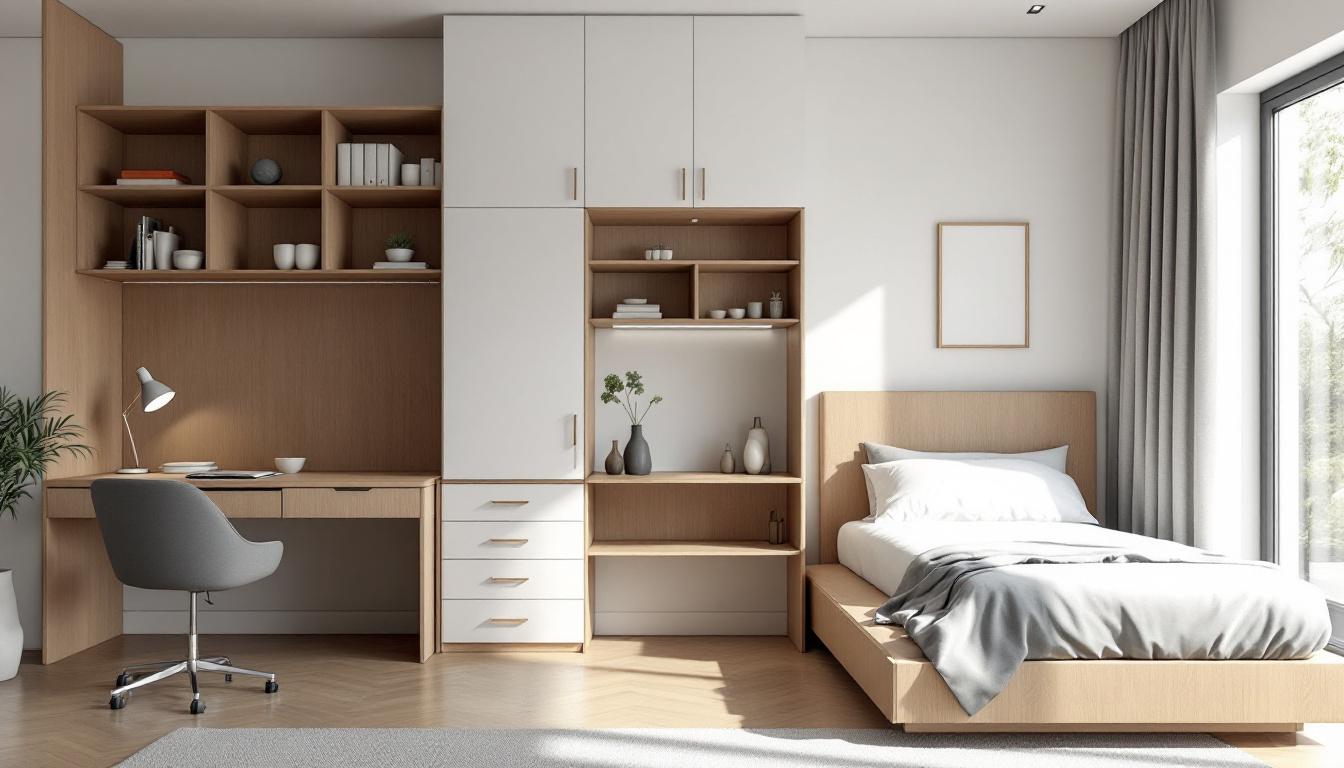
    **Space saving furniture manufacturer China** suppliers have emerged as global leaders in innovative compact living solutions. As urbanization accelerates worldwide and living spaces shrink, demand for multifunctional, transformable furniture has surged—and Chinese manufacturers are at the forefront of this design revolution, combining engineering innovation with cost-effective production. This guide provides procurement managers, retailers, and interior designers with actionable insights for sourcing space-saving furniture from China, covering supplier identification, technical requirements, quality standards, and logistics specific to transformable and multifunctional furniture. ## The Space-Saving Furniture Market in China China’s space-saving furniture sector has evolved from simple folding tables to sophisticated mechanical systems featuring hydraulic lifts, motorized transformations, and integrated smart home connectivity. This evolution reflects both domestic demand (China’s major cities have some of the world’s highest population densities) and export opportunities to space-constrained markets globally. ### Manufacturing Hub Specialization **Guangdong Province (Shenzhen, Dongguan, Foshan)** The innovation center for high-tech space-saving solutions. Manufacturers here specialize in: – Motorized wall beds (Murphy beds) with remote control – Hydraulic lift mechanisms for coffee-to-dining tables – Smart storage systems with app connectivity – Premium materials and finishes Typical positioning: Mid-to-high-end market, MOQs 50-100 units **Zhejiang Province (Ningbo, Taizhou)** Focus on mechanical space-saving furniture and outdoor convertible pieces: – Manual wall bed systems – Folding and extendable dining furniture – Convertible sofa beds – Balcony and compact outdoor furniture Typical positioning: Mid-range market, MOQs 30-80 units **Jiangsu Province (Suzhou, Changzhou)** Traditional woodworking expertise applied to space-saving designs: – Solid wood transformable furniture – Traditional-meets-modern Murphy beds – Custom built-in storage solutions – High-quality veneer finishes Typical positioning: Mid-to-high-end market, MOQs 50-100 units **Hebei Province (Langfang, Bazhou)** Budget-friendly mass production of popular space-saving items: – Basic wall bed mechanisms – Simple folding furniture – Entry-level sofa beds – Metal-frame convertible pieces Typical positioning: Budget market, MOQs 100-300 units ### Categories of Space-Saving Furniture from China **Wall Beds (Murphy Beds)** The flagship space-saving category, ranging from basic manual fold-up designs to sophisticated systems with integrated storage, desks, and shelving. Chinese manufacturers offer wall beds in vertical and horizontal orientations, with various mechanism types: – Spring-based systems (most common, cost-effective) – Piston/lift-assist systems (smoother operation, premium positioning) – Motorized systems (remote control, smart home integration) **Convertible Tables** Transformable dining and coffee tables that adjust height, expand surface area, or convert between functions: – Lift-top coffee tables (storage + work surface) – Extendable dining tables (seating 4-12 people) – Coffee-to-dining transformers (height and size adjustment) – Wall-mounted drop-leaf tables **Multifunctional Seating** Seating solutions with integrated storage or transformable functions: – Storage ottomans and benches – Sofa beds (click-clack, pull-out, and sectional convertibles) – Modular seating with reconfigurable components – Nesting chairs and stackable seating **Vertical Storage Systems** Maximizing vertical space utilization: – Ceiling-mounted storage lifts – Rotating wardrobe systems – Pull-down closet organizers – Wall-mounted folding desks **Modular and Transformable Systems** Integrated room systems combining multiple functions: – Complete studio apartment systems (bed + storage + desk + dining) – Sliding wall systems with integrated furniture – Pod and capsule furniture units – Reconfigurable room dividers with storage ## Selecting a Space Saving Furniture Manufacturer China Sourcing transformable furniture requires evaluating manufacturers on additional criteria beyond standard furniture sourcing. ### Technical Capability Assessment **Mechanical Engineering Expertise** Space-saving furniture involves complex mechanical systems. Evaluate: – In-house engineering team qualifications – CAD/CAM capabilities for mechanism design – Prototype development for custom mechanisms – Testing facilities for cycle testing and load testing – Patent portfolio (indicates innovation capability) **Mechanism Quality Standards** Request documentation on: – Cycle testing results (minimum 10,000 cycles for residential, 50,000 for commercial) – Load capacity testing (2x rated load minimum) – Safety testing (pinch point protection, tip-over resistance) – Material specifications for mechanical components (steel grade, bearing specifications) **Manufacturing Precision** Transformable furniture requires tight tolerances: – CNC machining capabilities for mechanism components – Quality control for moving parts (typically ±0.2mm tolerance) – Assembly expertise for complex mechanisms – Adjustment and calibration procedures ### Supplier Verification Checklist **Certifications and Compliance** – ISO 9001 quality management – Product safety certifications (CE marking for EU, UL listing for US where applicable) – Material safety compliance (CARB Phase 2, REACH) – Structural testing certifications (BIFMA for commercial applications) **Production Capabilities** – Dedicated space-saving furniture production lines – Mechanism assembly clean rooms or controlled environments – Testing stations for functional verification – Packaging designed for mechanism protection **Experience and References** – Years producing space-saving furniture specifically – Portfolio of completed projects – Client references in your target market – Case studies of custom mechanism development ## MOQs and Pricing for Space-Saving Furniture Space-saving furniture typically commands higher MOQs than standard furniture due to mechanism complexity and specialized production requirements. ### Typical MOQ Structures | Product Category | Standard MOQ | Custom Design MOQ | Notes | |—————–|————–|——————-|——-| | Wall Beds (Manual) | 30-50 units | 50-100 units | Mechanism complexity drives MOQ | | Wall Beds (Motorized) | 20-30 units | 30-50 units | Higher value, lower volume | | Lift-Top Coffee Tables | 50-100 units | 100-200 units | Popular item, competitive pricing | | Extendable Dining Tables | 50-100 units | 100-200 units | Mechanism-dependent MOQ | | Sofa Beds | 30-50 units | 50-100 units | Upholstery adds complexity | | Storage Ottomans | 100-200 units | 200-300 units | Simpler construction | | Modular Systems | 20-30 units | 30-50 units | Higher per-unit value | ### MOQ Reduction Strategies **Mechanism Standardization** Work with manufacturers’ existing mechanism platforms: – Use standard wall bed mechanisms with custom cabinetry – Specify standard lift systems with custom table designs – Leverage existing hardware for custom applications **Phased Rollouts** Negotiate ramp-up schedules: – Initial order at reduced MOQ with price premium (10-20%) – Commitment to volume targets over 12 months – Gradual price reduction as volumes increase **Collaborative Development** For innovative designs, offer: – Exclusive market rights for defined territories – Shared development costs – Long-term supply agreements ### Pricing Structure **Cost Components in Space-Saving Furniture** | Component | % of Total Cost | Notes | |———–|—————-|——-| | Mechanical Hardware | 25-40% | Highest cost component | | Wood/Frame Materials | 20-30% | Varies by material quality | | Upholstery (if applicable) | 15-25% | Fabric and foam | | Labor and Assembly | 15-20% | Higher skill requirement | | Finish and Hardware | 5-10% | Handles, trim, accessories | **Typical FOB Pricing Ranges** | Product | Budget Range | Mid-Range | Premium Range | |———|————–|———–|—————| | Manual Wall Bed (Queen) | $280-450 | $450-750 | $750-1,500 | | Motorized Wall Bed (Queen) | $800-1,200 | $1,200-2,000 | $2,000-4,000 | | Lift-Top Coffee Table | $80-150 | $150-300 | $300-600 | | Extendable Dining Table | $150-300 | $300-600 | $600-1,200 | | Sofa Bed (3-seat) | $200-400 | $400-800 | $800-1,500 | | Storage Ottoman | $30-60 | $60-120 | $120-250 | ## Quality Control for Transformable Furniture Space-saving furniture requires enhanced quality control due to safety-critical mechanical components. ### Incoming Material Inspection **Mechanical Components** – Steel specification verification (typically Q235 or 45# steel for load-bearing parts) – Bearing quality verification (NSK, SKF, or equivalent) – Hydraulic/pneumatic component testing – Hardware torque specifications – Spring rate verification for spring-based systems **Wood and Panel Materials** – Moisture content (6-8% for North America, 8-10% for Europe) – Formaldehyde emission (E0 or E1 grade) – Density and structural integrity for load-bearing panels – Veneer and laminate adhesion testing ### In-Process Quality Control **Mechanism Assembly Verification** – Torque specifications on all fasteners – Alignment verification for moving parts – Smoothness of operation testing – Safety interlock functionality – Load distribution verification **Frame and Cabinet Construction** – Dimensional accuracy (±1mm for visible components) – Squareness and alignment – Joint integrity (dowels, screws, brackets) – Edge banding quality ### Functional Testing Protocols **Cycle Testing** Every production batch should undergo: – Wall beds: Minimum 100 open/close cycles – Lift tables: 50 complete up/down cycles – Extendable tables: 50 extend/retract cycles – Sofa beds: 50 convert cycles **Load Testing** – Static load: 2x rated capacity for 24 hours – Dynamic load: Rated capacity through 1,000 cycles – Impact testing: Simulated real-world use impacts **Safety Testing** – Pinch point evaluation (gap analysis) – Tip-over resistance (stability testing) – Finger entrapment testing – Sharp edge and point inspection ### Final Inspection Standards **Operational Verification** – Smooth operation throughout full range of motion – Proper locking and safety mechanisms – Noise level within specifications (<50 dB typical) - Ease of operation (force requirements within spec) **Appearance Standards** - Finish consistency and color match - Hardware alignment and appearance - Upholstery quality (if applicable) - Packaging integrity ## Safety Standards and Certifications Space-saving furniture must meet stringent safety requirements due to moving parts and transformation mechanisms. ### International Safety Standards **United States** - **ASTM F2057**: Clothing storage unit tip-over resistance (applies to wall beds with storage) - **ASTM F2598**: Safety specification for fold-out beds - **CPSC 16 CFR 1213**: Safety standard for entrapment hazards - **UL 962**: Household and commercial furniture safety **European Union** - **EN 1129**: Domestic furniture—fold beds—safety requirements - **EN 14749**: Domestic and kitchen storage units and worktops - **EN 12520**: Domestic seating strength and durability - **CE marking**: Required for EU market access **Other Markets** - **Australia**: AS/NZS 4220 (folding beds) - **Japan**: JIS standards for furniture safety - **Canada**: CSA standards for furniture ### Testing and Certification Process **Third-Party Testing** Engage accredited laboratories for: - Initial product certification testing - Annual re-certification - Batch testing for ongoing production **Factory Production Control** Maintain compliance through: - Documented quality procedures - Regular internal audits - Calibration of testing equipment - Training records for quality personnel ## Logistics Considerations for Space-Saving Furniture Transformable furniture requires specialized handling and packaging due to mechanical components. ### Packaging Requirements **Mechanism Protection** - Individual wrapping of mechanical components - Desiccant packs to prevent corrosion - Foam padding around moving parts - Orientation markings ("This Side Up") **Knock-Down vs. Assembled** | Configuration | Advantages | Disadvantages | |--------------|------------|---------------| | Fully Assembled | Quality verified at factory, minimal customer assembly | Higher freight costs, damage risk during shipping | | Partial KD | Balanced approach, some pre-assembly | Moderate customer assembly required | | Full KD | Lowest freight cost, minimal damage risk | Complex customer assembly, quality dependent on assembly | Most space saving furniture manufacturer China suppliers offer partial knock-down packaging: - Mechanism pre-assembled and tested - Cabinet/frame components KD for shipping - Clear assembly instructions and hardware kit ### Shipping and Handling **Container Loading** - Wall beds typically ship 40-60 units per 40-foot container - Mixed loads possible with other furniture categories - Proper blocking and bracing essential for mechanism protection **Damage Prevention** - Corner protectors on all boxes - Palletizing for forklift handling - Clear handling instructions - Insurance coverage for high-value mechanisms ### Lead Times and Planning **Standard Production Lead Times** - Existing designs: 45-60 days - Modified designs: 60-75 days - Custom mechanisms: 90-120 days **Factors Affecting Lead Time** - Mechanism complexity - Material availability (specialty hardware) - Factory capacity (peak seasons) - Testing and certification requirements ## Innovation Trends in Chinese Space-Saving Furniture Staying current with manufacturing capabilities helps identify competitive opportunities. ### Smart Furniture Integration Chinese manufacturers increasingly offer: - App-controlled wall beds and tables - Voice assistant integration (Alexa, Google Home) - Automated transformation sequences - Occupancy sensors for safety - USB charging and power integration ### Material Innovations - Lightweight composites for easier transformation - Recycled and sustainable materials - Anti-bacterial surface treatments - Scratch and stain-resistant finishes - Fire-retardant materials for commercial applications ### Design Trends - Scandinavian minimalist aesthetics - Industrial loft styling - Mid-century modern influences - Japandi (Japanese-Scandinavian) fusion - Customizable finishes and configurations ## Building Supplier Relationships Long-term partnerships with space saving furniture manufacturer China suppliers yield significant benefits. ### Partnership Advantages - **Priority Production**: Established relationships secure capacity during peak seasons - **Co-Development Opportunities**: Joint innovation on new mechanisms - **Price Stability**: Long-term agreements protect against market fluctuations - **Quality Consistency**: Deep understanding of your standards over time - **Exclusive Designs**: Territory or channel exclusivity for proprietary products ### Relationship Management Best Practices - Annual factory visits to review capabilities and discuss roadmap - Quarterly business reviews to assess performance - Shared demand forecasting for production planning - Collaborative cost reduction initiatives - Joint participation in trade shows and market development ## Conclusion Sourcing from a space saving furniture manufacturer China offers access to innovative compact living solutions at competitive price points. Success requires understanding the technical complexity of transformable furniture, implementing rigorous quality control, and building strategic supplier partnerships. The space-saving furniture market continues to grow as urban living spaces shrink globally. By partnering with capable Chinese manufacturers and following the frameworks outlined in this guide, retailers and brands can offer compelling solutions that meet the evolving needs of space-conscious consumers. --- **Looking for space-saving furniture manufacturing partners?** Visit [FurnitureMadeInChina.com](https://furnituremadeinchina.com) to connect with verified space saving furniture manufacturers, explore their product catalogs, and request quotations for your specific requirements. Our team specializes in matching buyers with the right manufacturing partners for transformable and multifunctional furniture solutions.

  • OEM Furniture Manufacturer China: A Strategic Guide for Brand Owners and Retailers

    OEM Furniture Manufacturer China: A Strategic Guide for Brand Owners and Retailers

    **OEM furniture manufacturer China** partnerships have become the foundation of successful furniture brands worldwide. Whether you’re launching a new furniture line, expanding existing collections, or seeking to reduce production costs while maintaining quality, understanding how to effectively work with Chinese OEM manufacturers is critical for competitive positioning in today’s market. This comprehensive guide covers everything brand owners, retailers, and product developers need to know about establishing and managing OEM furniture manufacturing relationships in China—from initial supplier identification to quality assurance and intellectual property protection. ## Understanding OEM Furniture Manufacturing in China OEM (Original Equipment Manufacturer) furniture production involves manufacturing products based on your designs and specifications, sold under your brand name. This differs from ODM (Original Design Manufacturer) where the factory provides existing designs, and white-label manufacturing where generic products are rebranded. ### The Chinese OEM Furniture Ecosystem China’s OEM furniture sector comprises a sophisticated network of manufacturers organized by specialization, scale, and export experience. The ecosystem has evolved significantly over the past decade, with many factories transitioning from pure manufacturing to offering value-added services including design refinement, material sourcing, and logistics coordination. **Manufacturing Cluster Distribution** | Region | Specialization | Typical OEM MOQ | Price Position | |——–|—————|—————–|—————-| | Guangdong (Foshan) | Comprehensive furniture, high-end | 100-300 units | Mid-to-high | | Zhejiang (Hangzhou/Ningbo) | Upholstery, modern designs | 50-200 units | Mid-range | | Fujian (Quanzhou/Xiamen) | Metal furniture, outdoor | 100-500 units | Budget-to-mid | | Jiangsu (Suzhou/Changzhou) | Solid wood, traditional styles | 100-300 units | Mid-to-high | | Hebei (Langfang/Bazhou) | Upholstered furniture, budget | 50-150 units | Budget | | Shandong (Qingdao) | Wood furniture, Japanese/Korean export | 100-300 units | Mid-range | ### Types of OEM Furniture Manufacturers **Full-Service OEM Partners** These manufacturers handle the complete production cycle from material sourcing to finished goods, including design optimization for manufacturing. They typically require higher MOQs (200+ units) but offer the most streamlined experience. **Component Specialists** Factories focusing on specific manufacturing processes—upholstery, woodworking, metal fabrication, or finishing. These work well for complex products requiring multiple specialized processes, coordinated by a primary manufacturer or trading company. **Flexible Small-Batch Manufacturers** Emerging manufacturers catering to startups and e-commerce brands with lower MOQs (30-100 units) and faster turnaround times. Often utilize more automated, flexible manufacturing systems. ## Finding and Evaluating OEM Furniture Manufacturers The supplier selection process for OEM manufacturing requires thorough evaluation across multiple dimensions. ### Sourcing Channels **Industry Trade Shows** – CIFF (China International Furniture Fair) – Guangzhou, March and September – Shanghai Furniture Fair – September – IMM Cologne (Chinese manufacturer pavilion) – January – High Point Market (Chinese exhibitor section) – April/October **B2B Platforms** – Alibaba.com: Extensive supplier database with trade assurance – Global Sources: Focus on export-ready manufacturers – Made-in-China.com: Strong furniture category presence – ThomasNet: North America-focused with Chinese supplier listings **Industry Associations** – China National Furniture Association (CNFA) – Local chamber of commerce connections – Industry-specific trade organizations ### Evaluation Criteria for OEM Partners **Technical Capabilities Assessment** Request documentation and samples demonstrating: – Engineering drawing interpretation (CAD, SolidWorks files) – Prototype development capabilities – Material substitution recommendations for cost optimization – Manufacturing tolerance capabilities (typically ±0.5mm for furniture) – Finish matching and color consistency control **Production Capacity Analysis** Verify ability to meet your volume requirements: – Monthly production capacity by product category – Current capacity utilization (aim for partners under 80% utilization) – Equipment list and age (CNC machines, edge banders, finishing lines) – Shift operations (single, double, or triple shift) – Peak season capacity constraints **Quality Management Systems** Essential certifications and systems: – ISO 9001:2015 quality management – Incoming material inspection protocols – In-process quality checkpoints – Final inspection and testing procedures – Defect tracking and corrective action systems – AQL (Acceptable Quality Level) standards **Financial Stability Verification** Protect your investment by verifying: – Business registration and legal structure – Years in operation (prefer 5+ years for primary partners) – Export license and experience – Bank references – Trade insurance ratings – Major client portfolio ## OEM Manufacturing MOQs and Pricing Structures Understanding MOQ structures and pricing components enables effective negotiation and cost planning. ### Typical OEM Furniture MOQs | Product Category | Startup MOQ | Standard MOQ | Volume MOQ | |—————–|————-|————–|————| | Dining Chairs | 50-100 | 100-200 | 300+ | | Dining Tables | 30-50 | 50-100 | 200+ | | Sofas (2-3 seat) | 20-30 | 30-50 | 100+ | | Armchairs | 30-50 | 50-100 | 200+ | | Coffee Tables | 50-100 | 100-200 | 300+ | | Bed Frames | 30-50 | 50-100 | 200+ | | Storage Units | 30-50 | 50-100 | 200+ | | Outdoor Furniture | 50-100 | 100-200 | 300+ | ### MOQ Negotiation Strategies **Mixed Container Loads** Most OEM furniture manufacturers China accept mixed SKU orders to fill containers: – 20-foot container: Minimum 25-28 CBM total volume – 40-foot container: Minimum 55-60 CBM total volume – Combine multiple SKUs to reach container minimums while keeping per-SKU quantities lower **Material Sharing** Negotiate lower MOQs by using common materials across multiple SKUs: – Same wood species with different stains – Common upholstery fabrics across chair models – Shared hardware and components **Phased Production** For new product launches, negotiate: – Initial trial order at reduced MOQ (50-75% of standard) – Commitment to reach full MOQ within 6-12 months – Surcharge of 10-20% for below-standard MOQ ### Pricing Structure Components **NRE (Non-Recurring Engineering) Costs** One-time costs for new OEM products: – Mold and tooling: $500-5,000 depending on complexity – Sample development: $200-1,000 per SKU – Documentation and specification development: $300-800 **Unit Pricing Factors** | Cost Component | Typical Range | Notes | |—————|—————|——-| | Raw Materials | 35-45% of unit cost | Wood, metal, foam, fabric, hardware | | Direct Labor | 15-25% of unit cost | Varies by region and complexity | | Manufacturing Overhead | 10-15% of unit cost | Factory utilities, maintenance, management | | Packaging | 3-8% of unit cost | Depends on protection requirements | | Factory Margin | 10-20% of unit cost | Varies by factory and order size | **Price Validity and Adjustment Clauses** Standard OEM agreements should include: – Price validity periods (typically 6-12 months) – Material price fluctuation adjustments (triggered by >5% commodity price change) – Currency adjustment mechanisms for multi-year agreements – Volume discount tiers (typically 3-5% at 2x MOQ, 5-10% at 5x MOQ) ## The OEM Product Development Process Successful OEM manufacturing requires structured product development collaboration. ### Phase 1: Design Transfer (Weeks 1-3) **Documentation Package** Provide comprehensive design documentation: – 3D CAD files (STEP, IGES, or native SolidWorks/Inventor) – 2D technical drawings with dimensions and tolerances – Material specifications (wood species, fabric codes, hardware specs) – Finish specifications (stain colors, paint codes, sheen levels) – Assembly instructions and exploded views – Packaging requirements and branding specifications **Design for Manufacturing (DFM) Review** Expect your OEM furniture manufacturer China to provide: – Manufacturability feedback and suggested improvements – Material substitution recommendations for cost reduction – Assembly optimization suggestions – Tolerance relaxation recommendations where appropriate – Alternative construction methods evaluation ### Phase 2: Prototyping (Weeks 4-8) **Sample Development Timeline** – First prototype: 2-3 weeks – Revision rounds: 1-2 weeks each – Final pre-production sample: 2-3 weeks **Prototype Evaluation Checklist** Evaluate samples against: – Dimensional accuracy (measure critical dimensions) – Material authenticity (verify specified materials) – Construction quality (joinery, fastening, reinforcement) – Finish quality (color match, consistency, durability) – Functionality (moving parts, adjustability, stability) – Weight and structural integrity ### Phase 3: Production Preparation (Weeks 9-10) **Pre-Production Activities** – Final engineering sign-off – Material procurement and incoming inspection – Production tooling setup and validation – Operator training for new products – Quality control protocol finalization – Packaging design approval ### Phase 4: Production and Quality Control (Weeks 11-18) **Production Monitoring** – Weekly production reports – In-process inspection at 20%, 50%, and 80% completion – Final pre-shipment inspection (AQL 2.5 major, 4.0 minor) – Packaging inspection and container loading supervision ## Quality Assurance for OEM Furniture Maintaining consistent quality across production runs requires systematic quality management. ### Incoming Material Control **Wood and Wood Products** – Moisture content verification (6-10% depending on destination climate) – Grade verification against specifications – Dimensional stability testing – Certification verification (FSC, CARB compliance) **Upholstery Materials** – Fabric weight and composition testing – Color fastness testing (wash, light, rubbing) – Abrasion resistance (Wyzenbeek or Martindale methods) – Flammability testing (CAL 117, BS 5852 as required) **Hardware and Components** – Load testing for structural hardware – Cycle testing for moving parts (drawer slides, hinges) – Corrosion resistance testing for metal components – Dimensional verification ### In-Process Quality Control **Critical Control Points** – Cut parts dimensional verification – Joinery quality inspection – Upholstery frame construction – Foam density and placement – Finish application consistency – Assembly accuracy **Statistical Process Control** Implement SPC for high-volume production: – Control charts for critical dimensions – Process capability studies (Cpk > 1.33 minimum) – Corrective action triggers and procedures ### Final Inspection Protocols **AQL Sampling Plans** Standard furniture inspection uses General Inspection Level II: – Lot size 501-1,200: Sample 80 pieces – Lot size 1,201-3,200: Sample 125 pieces – Lot size 3,201-10,000: Sample 200 pieces Acceptance criteria: – Critical defects: 0 allowed – Major defects (AQL 2.5): Functional issues, safety concerns, significant appearance defects – Minor defects (AQL 4.0): Minor appearance issues, non-functional discrepancies **Testing Protocols** Conduct or witness testing for: – Static load testing (2x rated capacity) – Dynamic load testing (repeated loading cycles) – Stability testing (tip-over resistance) – Finish adhesion testing (cross-hatch method) – Hardware functionality testing ## Intellectual Property Protection Protecting your designs when working with OEM furniture manufacturers China requires proactive measures. ### Legal Protections **Contracts and Agreements** – NDA (Non-Disclosure Agreement): Before sharing designs – NNN Agreement (Non-Use, Non-Disclosure, Non-Circumvention): Comprehensive protection – OEM Manufacturing Agreement: Detailed production terms – IP Assignment/Protection clauses **Intellectual Property Registration** – Design patents in China (if applicable) – Trademark registration in China – Copyright registration for original designs – Utility patents for novel mechanisms or features ### Operational Protections **Design Fragmentation** – Split component manufacturing across multiple suppliers – Provide final assembly specifications only to trusted partners – Use code names for sensitive products **Relationship Management** – Exclusive manufacturing agreements for proprietary designs – Regular relationship reviews and facility visits – Clear communication of IP expectations – Gradual trust building before sharing core designs ## Logistics and Supply Chain Management Efficient logistics management ensures timely delivery and cost control. ### Shipping Options **Full Container Load (FCL)** – 20-foot container: ~28 CBM capacity – 40-foot container: ~58 CBM capacity – 40-foot high cube: ~68 CBM capacity – Most economical for orders filling 75%+ of container **Less than Container Load (LCL)** – Suitable for smaller orders – 30-40% higher cost per CBM than FCL – Higher handling risk – Consolidation delays at origin **Multi-Modal Options** – Sea-air combination for time-sensitive orders – Rail freight (China-Europe) for mid-urgency orders – Express courier for samples and small urgent shipments ### Lead Time Management **Standard Production Lead Times** – Repeat orders: 45-60 days – New products: 60-90 days – Complex custom products: 90-120 days **Lead Time Reduction Strategies** – Forecast sharing with manufacturers – Raw material pre-positioning agreements – Expedited production scheduling (premium 15-25%) – Air freight for critical path items ### Inventory and Replenishment Strategies **Economic Order Quantity (EOQ)** Balance ordering costs against holding costs: – Consider freight consolidation benefits – Factor in supplier minimum order requirements – Account for demand variability **Safety Stock Planning** – Calculate safety stock based on demand variability and lead time uncertainty – Typical safety stock: 2-4 weeks of average demand – Review and adjust quarterly ## Building Successful OEM Partnerships Long-term OEM relationships deliver better pricing, priority scheduling, and collaborative improvement. ### Partnership Development Stages **Stage 1: Transactional (Months 1-6)** – Focus on execution and quality verification – Establish communication protocols – Build mutual understanding of expectations **Stage 2: Cooperative (Months 6-18)** – Share demand forecasts – Collaborate on cost reduction initiatives – Develop streamlined processes **Stage 3: Strategic (18+ Months)** – Joint product development – Exclusive manufacturing arrangements – Shared continuous improvement programs – Integrated planning and forecasting ### Communication Best Practices **Regular Touchpoints** – Weekly production updates during active orders – Monthly business reviews – Quarterly strategic planning sessions – Annual face-to-face meetings (factory visits) **Clear Documentation** – Written confirmation of all verbal agreements – Detailed specifications for every order – Change order documentation – Quality feedback and corrective action tracking ## Conclusion Working with an OEM furniture manufacturer China offers significant competitive advantages for furniture brands and retailers. Success requires thorough supplier qualification, clear communication, robust quality systems, and intellectual property protection. The investment in developing strong OEM partnerships pays dividends through cost optimization, product quality, and supply chain reliability. By following the frameworks outlined in this guide—from initial supplier evaluation to long-term partnership management—you can build a manufacturing foundation that supports sustainable business growth. — **Ready to explore OEM furniture manufacturing partnerships?** Visit [FurnitureMadeInChina.com](https://furnituremadeinchina.com) to connect with verified OEM furniture manufacturers, request quotations for your designs, and access our comprehensive supplier verification resources. Our team can help match your specific requirements with the right manufacturing partners across China’s furniture production regions.

  • Hotel Furniture Manufacturers China: A Strategic Sourcing Guide for Hospitality Procurement

    Hotel Furniture Manufacturers China: A Strategic Sourcing Guide for Hospitality Procurement

    **Hotel furniture manufacturers China** have become the preferred sourcing destination for hospitality projects worldwide, supplying everything from budget boutique hotels to five-star luxury properties. With over 60% of global hotel furniture production originating from China, understanding how to work with these specialized manufacturers is essential for hotel developers, procurement managers, and interior design firms. This guide provides actionable insights for sourcing hotel furniture from China, covering supplier qualification, project management, quality standards, and logistics specific to hospitality industry requirements. ## The China Hotel Furniture Manufacturing Landscape China’s hotel furniture sector operates distinctly from residential furniture manufacturing. Specialized factories understand the unique demands of commercial hospitality environments—durability requirements, fire safety standards, rapid turnaround needs, and brand consistency across multiple properties. ### Regional Manufacturing Hubs **Guangdong Province (Foshan, Dongguan, Shenzhen)** The epicenter of hotel furniture manufacturing, hosting over 3,000 specialized factories. Foshan alone accounts for approximately 40% of China’s hotel furniture exports. Manufacturers here excel in mid-to-high-end custom furniture and complete FF&E (Furniture, Fixtures, and Equipment) packages. **Zhejiang Province (Hangzhou, Ningbo)** Known for modern and contemporary hotel furniture styles. Strong in metal and mixed-material construction, popular with boutique and design-forward hotel brands. **Jiangsu Province (Suzhou)** Traditional craftsmanship heritage combined with modern manufacturing. Specializes in luxury hotel furniture with intricate detailing and premium materials. **Hebei and Shandong Provinces** Emerging hubs focusing on budget to mid-range hotel furniture with competitive pricing and faster production cycles. ### Types of Hotel Furniture Manufacturers **Full-Service FF&E Providers** These companies manage entire hotel furnishing projects, coordinating furniture, lighting, artwork, and accessories. Ideal for new hotel builds or complete renovations requiring single-source accountability. **Specialized Category Manufacturers** Factories focusing on specific product categories—casegoods (wardrobes, dressers, nightstands), seating (lobby furniture, restaurant chairs), or sleep systems (beds, headboards, mattresses). **Custom Workshop Operations** Smaller manufacturers specializing in bespoke pieces for luxury properties requiring unique designs and premium materials. ## Supplier Selection for Hotel Projects Selecting hotel furniture manufacturers China requires more rigorous vetting than residential furniture sourcing due to project complexity and compliance requirements. ### Essential Qualifications to Verify **Hospitality Industry Experience** Request portfolios showing completed hotel projects, preferably in your target market segment. Look for: – Minimum 5 years of hotel furniture manufacturing experience – References from hotel brands comparable to your project – Understanding of hospitality operational requirements (housekeeping efficiency, durability standards) **Compliance Certifications** Hotel furniture must meet stringent safety and performance standards: – **CAL 117 / TB 117-2013**: California fire safety standards (widely adopted internationally) – **BS 5852**: UK fire resistance standards – **ASTM F2057**: Clothing storage unit safety (anti-tip requirements) – **BIFMA X5.4**: Lounge and public seating durability (50,000+ cycle testing) – **ISO 14001**: Environmental management systems **Financial Stability Assessment** Hotel projects often span 6-12 months with significant payment milestones. Verify manufacturer financial health through: – Business registration and capital verification – Bank references – Trade insurance reports – Years in continuous operation ### Factory Audit Checklist Before finalizing any hotel furniture manufacturer China, conduct or commission a comprehensive factory audit covering: **Production Capabilities** – CNC machining centers for precision manufacturing – Upholstery workshops with industrial sewing equipment – Finishing facilities with spray booths and curing ovens – Quality control stations with testing equipment **Project Management Infrastructure** – Dedicated project managers with English proficiency – CAD/CAM capabilities for technical drawings – Sample development workshop for mock-up production – Installation team or partnerships for destination market **Capacity and Scalability** – Current order book and production schedule – Ability to surge capacity for large projects – Subcontractor relationships for overflow capacity – Raw material inventory and supplier relationships ## Understanding Hotel Furniture MOQs and Pricing Hotel furniture projects differ significantly from retail furniture purchasing in terms of order structure and pricing models. ### Typical MOQ Structures **Room Package Orders** Most hotel furniture manufacturers China structure MOQs around complete room packages: – Minimum 20-50 rooms for standard designs – Minimum 50-100 rooms for custom designs – Mixed room types (standard, suite, accessible) typically accepted within MOQ **Public Area Furniture** – Lobby seating: 10-20 pieces per style – Restaurant chairs: 30-50 pieces minimum – Bar stools: 20-30 pieces minimum – Conference tables: 5-10 tables **Value Engineering Options** For projects below standard MOQs, manufacturers may offer: – Modified designs using existing components – Extended production timelines to combine with other orders – Surcharges of 15-25% for below-MOQ orders ### Pricing Models **Per-Room Pricing** Many hotel furniture manufacturers China offer packaged per-room pricing for standard room types: – Budget/Economy: $2,500-4,000 per room – Mid-Scale: $4,500-7,500 per room – Upscale: $8,000-15,000 per room – Luxury: $15,000-40,000+ per room **Component Pricing** For custom projects or mixed procurement: – Headboards: $180-600 (depending on size and materials) – Nightstands: $120-350 – Dressers: $280-650 – Wardrobes: $450-1,200 – Desk/vanity units: $200-500 – Lounge chairs: $250-800 – Sofa beds: $600-1,500 **Factors Affecting Pricing** – Wood species (oak, walnut, ash, rubberwood, or veneers) – Upholstery grade (commercial vs. residential fabric) – Hardware quality (soft-close drawers, European hinges) – Finish complexity (stain matching, distressing, specialty finishes) – Project timeline (rush orders incur 20-30% premiums) ## Quality Standards for Hotel Furniture Hotel furniture must withstand intensive daily use while maintaining appearance standards. Understanding quality benchmarks ensures appropriate specifications. ### Durability Requirements **Casegoods (Wardrobes, Dressers, Nightstands)** – Drawer slides: 50,000+ cycle rating (minimum 100 lb capacity) – Hinges: 100,000+ cycle rating – Edge banding: 2mm PVC minimum, preferably 3mm – Shelf loading: 75+ lb static load capacity – Tip-over prevention: Wall-anchoring hardware included **Seating (Chairs, Sofas, Lounge Furniture)** – Frame construction: Kiln-dried hardwood, corner-blocked and glued – Spring systems: 8-way hand-tied or sinuous spring with minimum 11-gauge wire – Foam density: 2.0+ lb density for seat cushions, 1.8+ for backs – Fabric durability: 50,000+ double rubs (Wyzenbeek method) – Frame warranty: Minimum 10 years commercial use **Sleep Systems** – Bed frames: Center support legs required for queen and larger – Headboards: Secure wall-mounting systems – Mattress foundations: Rigid platform or slat systems (no box springs) ### Finish Quality Standards **Wood Finishes** – Pre-catalyzed lacquer or conversion varnish minimum – 4-5 coat system for high-traffic surfaces – UV resistance for sun-exposed pieces – Chemical resistance testing (cleaning products, alcohol) **Metal Finishes** – Powder coating for durability – 1,000+ hour salt spray testing for corrosion resistance – Proper surface preparation (phosphate treatment, sanding) ## Project Management and Production Timelines Hotel furniture projects require meticulous coordination between design approval, production, shipping, and installation. ### Standard Project Timeline | Phase | Duration | Key Activities | |——-|———-|—————-| | Design Development | 4-8 weeks | Concept refinement, material selection, technical drawings | | Sample Production | 6-10 weeks | Mock-up room or sample pieces for approval | | Production | 10-16 weeks | Mass manufacturing with quality checkpoints | | Shipping | 4-6 weeks | Ocean freight to destination port | | Installation | 2-4 weeks | Unpacking, assembly, placement, final inspection | | **Total Project Duration** | **26-44 weeks** | From design approval to project completion | ### Critical Path Management **Sample Approval Phase** The sample approval process is the most critical milestone. Rushing this phase often results in production errors that are expensive to correct. Budget 2-3 rounds of sample revisions for custom designs. **Production Monitoring** Establish inspection checkpoints: – Material incoming inspection (verify wood species, fabric lots) – In-process inspection (joinery, upholstery frames) – Pre-finishing inspection (sanding, preparation quality) – Final inspection (complete assembly, finish quality) – Pre-shipment inspection (packaging, labeling, documentation) **Shipping Coordination** Hotel furniture often requires specialized shipping: – Flat-pack vs. assembled shipment (affects freight costs and installation time) – White glove delivery requirements – Coordination with hotel construction/renovation schedules – Storage solutions if site not ready for delivery ## Logistics and Shipping for Hotel Projects Hotel furniture shipments require specialized handling due to volume, value, and coordination requirements. ### Shipping Configuration Options **Fully Assembled (KD-0)** Furniture ships completely assembled. Highest freight costs but minimal on-site labor. Best for high-value pieces or markets with limited installation capability. **Partially Assembled (KD-5 to KD-10)** Moderate disassembly for shipping (legs removed, backs detached). Balanced approach for most hotel projects. **Knock-Down Flat Pack (KD-100)** Maximum disassembly for container efficiency. Requires significant on-site assembly labor but reduces freight costs by 40-60%. ### Container Loading Strategies **Floor-Loaded Containers** For large projects, floor-loaded containers (without pallets) maximize space utilization. Requires factory loading expertise and destination unloading equipment. **Palletized Loads** Standard pallets facilitate handling but reduce container capacity by 15-20%. Recommended for smaller shipments or destinations with limited handling equipment. **Mixed Loading** Combining assembled casegoods with flat-packed seating optimizes space while managing labor requirements. ### Import Considerations **Customs Documentation** Hotel furniture imports require: – Detailed commercial invoices with HS codes – Packing lists with piece counts and dimensions – Certificates of origin for duty preference claims – Fumigation certificates (ISPM-15 compliant wood packaging) – Fire safety compliance documentation **Duty and Tax Planning** Hotel furniture typically falls under HS codes 9403 (furniture and parts). Duty rates vary by country: – United States: 0-25% depending on product category and origin – European Union: 0-5% for most furniture categories – Australia: 5% general rate – Middle East: Generally duty-free ## Risk Mitigation Strategies Hotel furniture projects involve significant capital investment. Implement these risk mitigation strategies: ### Financial Protections – **Letter of Credit (L/C)**: Secure payment through documentary credit for large orders – **Trade Credit Insurance**: Protect against manufacturer default – **Escrow Services**: Use third-party escrow for initial deposits with new suppliers – **Milestone Payments**: Structure payments tied to verifiable milestones (sample approval, production start, pre-shipment, delivery) ### Quality Assurance – **Third-Party Inspection**: Engage SGS, Bureau Veritas, or equivalent for pre-shipment inspection – **Factory Surveillance**: Schedule unannounced inspections during production – **Sample Retention**: Retain approved samples for production comparison – **Photographic Documentation**: Require factory photos at each production stage ### Contract Protections – **Detailed Specifications**: Attach complete technical specifications to purchase orders – **Liquidated Damages**: Include penalties for late delivery – **Quality Guarantees**: Define acceptable quality levels and remedy procedures – **Intellectual Property Protection**: Include confidentiality and non-compete clauses for custom designs ## Sustainability in Hotel Furniture Sourcing Environmental responsibility increasingly influences hotel brand positioning and guest preferences. ### Sustainable Sourcing Practices **Material Certification** – FSC-certified wood and wood products – Greenguard certification for low chemical emissions – Recycled content materials where appropriate – Rapidly renewable materials (bamboo, rattan) **Manufacturing Standards** – ISO 14001 environmental management – Water-based finishes and adhesives – Waste reduction and recycling programs – Energy-efficient manufacturing processes **End-of-Life Considerations** – Design for disassembly – Recyclable material selection – Take-back programs for furniture replacement ## Building Strategic Partnerships Long-term relationships with hotel furniture manufacturers China yield significant advantages: – **Preferred Pricing**: Volume commitments secure better pricing – **Priority Production**: Established partners receive scheduling preference – **Design Collaboration**: Joint development of proprietary furniture collections – **Market Intelligence**: Early access to new materials and manufacturing techniques – **Global Support**: Multi-regional service capabilities for international hotel groups ## Conclusion Sourcing from hotel furniture manufacturers China requires specialized knowledge, rigorous supplier qualification, and meticulous project management. The investment in proper due diligence pays dividends through competitive pricing, consistent quality, and reliable delivery. Success depends on viewing Chinese manufacturers as strategic partners rather than commodity suppliers. By establishing clear specifications, implementing robust quality control, and maintaining open communication, hotel developers and procurement managers can leverage China’s manufacturing capabilities while meeting the exacting standards of the hospitality industry. — **Planning a hotel furniture project?** Visit [FurnitureMadeInChina.com](https://furnituremadeinchina.com) to connect with verified hotel furniture manufacturers, request detailed quotations, and access our hospitality procurement resources. Our team specializes in matching hotel projects with the right manufacturing partners across China’s hotel furniture production centers.

  • Wholesale Solid Wood Furniture from China: A Complete Procurement Guide for Importers

    Wholesale Solid Wood Furniture from China: A Complete Procurement Guide for Importers

    **Wholesale solid wood furniture from China** represents one of the most lucrative opportunities for furniture retailers, interior designers, and hospitality businesses seeking quality craftsmanship at competitive prices. With China’s furniture manufacturing industry valued at over $100 billion annually, understanding how to navigate this market can significantly impact your bottom line. This comprehensive guide walks procurement managers and importers through every stage of sourcing wholesale solid wood furniture from China—from supplier selection to final delivery. ## Why Source Solid Wood Furniture from China? China’s furniture manufacturing sector has evolved dramatically over the past two decades. What began as a hub for low-cost, mass-produced items has transformed into a sophisticated industry capable of producing high-quality solid wood furniture that meets international standards. ### Key Advantages of Chinese Solid Wood Furniture Manufacturing **Cost Efficiency Without Compromising Quality** Chinese manufacturers benefit from vertical integration, controlling everything from timber sourcing to final finishing. This integration typically results in 30-40% cost savings compared to European or North American suppliers, while maintaining comparable quality standards. **Material Variety and Availability** China offers access to diverse wood species including oak, walnut, ash, rubberwood, and bamboo. Many manufacturers maintain direct relationships with sustainable forestry operations in Southeast Asia, Africa, and domestic plantations, ensuring consistent material supply. **Manufacturing Scale and Flexibility** Whether you need 50 custom dining tables or 5,000 standardized bedroom sets, Chinese factories can accommodate orders across the spectrum. This scalability makes wholesale solid wood furniture from China suitable for businesses of all sizes. ## Supplier Selection: Finding the Right Manufacturing Partner Selecting the right supplier is perhaps the most critical decision in your procurement journey. The wrong choice can result in quality issues, delivery delays, and financial losses. ### Types of Solid Wood Furniture Manufacturers in China **Tier 1: Large-Scale Export Manufacturers** These factories typically employ 500+ workers and serve major international brands. They offer the highest consistency and compliance with international standards but often require larger minimum order quantities (MOQ 100-300 pieces per SKU). **Tier 2: Mid-Sized Specialized Manufacturers** With 100-500 workers, these factories often specialize in specific categories (dining furniture, bedroom sets, office furniture). They offer better flexibility with MOQs typically ranging from 50-100 pieces and more personalized service. **Tier 3: Small Workshops and Trading Companies** While offering the lowest MOQs (sometimes 20-30 pieces), these suppliers present higher risks regarding quality consistency and production capacity. Best suited for trial orders or highly customized small batches. ### Verification Checklist for Potential Suppliers Before committing to any manufacturer, verify the following: – **Business License and Export Rights**: Request copies of their business registration and customs registration certificates – **Factory Audit Reports**: Look for ISO 9001, ISO 14001, or FSC Chain of Custody certifications – **Client References**: Ask for contact information of existing international clients – **Production Facilities**: Request video tours or arrange third-party factory inspections – **Quality Control Processes**: Understand their incoming material inspection, in-process QC, and final inspection protocols ### Recommended Sourcing Platforms – **Alibaba.com**: Largest B2B platform with extensive supplier verification systems – **Global Sources**: Focuses on export-ready manufacturers with trade show presence – **Made-in-China.com**: Strong in furniture categories with factory audit reports – **Industry Trade Shows**: CIFF (China International Furniture Fair) in Guangzhou and Shanghai Furniture Fair offer direct factory access ### Red Flags to Avoid When evaluating potential suppliers for wholesale solid wood furniture from China, watch for these warning signs: – **Unwillingness to provide factory address or allow visits**: Legitimate manufacturers welcome inspections – **Prices significantly below market rates**: Often indicates material substitution or quality shortcuts – **No export experience**: First-time exporters may struggle with documentation and compliance – **Pressure for large upfront payments**: Standard terms are 30% deposit, 70% before shipment – **Inability to provide material certifications**: Critical for verifying solid wood claims – **No quality control documentation**: Professional factories maintain detailed QC records ## Understanding Minimum Order Quantities (MOQ) MOQ structures vary significantly based on manufacturer size, product complexity, and customization requirements. ### Standard MOQ Ranges for Solid Wood Furniture | Product Category | Standard MOQ | Custom Design MOQ | |—————–|————–|——————-| | Dining Chairs | 50-100 pieces | 100-200 pieces | | Dining Tables | 30-50 pieces | 50-100 pieces | | Bed Frames | 30-50 pieces | 50-100 pieces | | Nightstands | 50-100 pieces | 100-200 pieces | | Wardrobes | 20-30 pieces | 30-50 pieces | | Coffee Tables | 50-100 pieces | 100-200 pieces | ### Negotiating MOQs Many manufacturers are willing to negotiate MOQs, especially for: – First-time orders to establish relationships – Mixed container loads (combining multiple SKUs) – Off-peak production seasons (typically Chinese New Year period, January-February) – Long-term partnership commitments Strategy: Start with a trial order at standard MOQ, then negotiate reduced MOQs for repeat orders based on performance. ## Quality Control: Ensuring Product Standards Quality control for solid wood furniture requires attention to material authenticity, construction methods, and finishing standards. ### Material Verification **Wood Species Authentication** Request material certificates specifying exact wood species. Common substitutions include rubberwood marketed as oak, or MDF cores with wood veneer sold as solid wood. Insist on written specifications and consider third-party material testing for high-value orders. **Moisture Content Standards** Properly dried wood is essential for furniture stability. International standards specify: – 6-8% moisture content for furniture exported to North America – 8-10% for European destinations – 10-12% for tropical climates Request moisture content test reports and specify requirements in your purchase contracts. ### Construction Quality Standards **Joinery Methods** Quality solid wood furniture should feature: – Dovetail joints in drawer construction (not stapled or glued corners) – Mortise and tenon joints for structural connections – Proper wood expansion gaps in panel construction – Corner blocks in chair and table construction **Finish Quality** Inspect for: – Even stain application without blotching – Smooth surface preparation (180-220 grit minimum) – Appropriate clear coat thickness (2-3 coats for residential, 4-5 for commercial) – Proper curing time between coats (minimum 24 hours) ### Quality Control Protocols **Pre-Production Samples (PPS)** Always approve pre-production samples before mass production begins. This sample serves as the quality benchmark for the entire order. **During Production Inspection (DUPRO)** For orders exceeding $30,000, arrange inspection when 20-30% of production is complete. This allows for early identification of systematic issues. **Pre-Shipment Inspection (PSI)** Mandatory for all orders. Standard AQL (Acceptable Quality Level) for furniture is 2.5% major defects, 4.0% minor defects. Consider hiring third-party inspection services like SGS, Bureau Veritas, or AsiaInspection for orders over $50,000. ## Logistics and Shipping Considerations Efficient logistics planning prevents costly delays and damage during transit. ### Shipping Methods **Full Container Load (FCL)** Most economical for orders filling at least 20-25 cubic meters: – 20-foot container: approximately 28-30 CBM capacity – 40-foot container: approximately 58-60 CBM capacity – 40-foot high cube: approximately 68-70 CBM capacity **Less than Container Load (LCL)** Suitable for smaller orders but costs 30-40% more per cubic meter than FCL. Higher risk of damage due to multiple handling points. **Lead Times** – Standard production: 45-60 days after sample approval – Custom designs: 60-90 days – Peak season (August-October): Add 15-20 days – Chinese New Year impact: Plan for 4-6 week production shutdown ### Packaging Requirements Proper packaging is essential for solid wood furniture: – Individual PE foam wrapping for all surfaces – Corner protection with foam or cardboard – Carton boxes for smaller items – Crate packaging for high-value or fragile pieces – Moisture barrier bags for ocean freight – Clear handling instructions and “This Side Up” markings ### Import Documentation Ensure your supplier provides: – Commercial invoice – Packing list – Bill of lading – Certificate of origin – FSC or other sustainability certifications (if applicable) – Fumigation certificate (required for wooden products in many countries) ### Customs and Duty Considerations Import duties on solid wood furniture vary significantly by destination country: – **United States**: 0-25% depending on HTS code classification and country of origin – **European Union**: Generally 0-5% for most solid wood furniture – **Australia**: 5% general rate, with potential preferential rates under trade agreements – **Canada**: 0-9.5% depending on product category – **Middle East**: Most countries duty-free for furniture imports Working with experienced freight forwarders familiar with furniture imports can help optimize HS code classification and minimize duty exposure. Some manufacturers can also provide guidance based on their export experience to your market. ## Cost Structure and Pricing Understanding the complete cost structure helps in budget planning and price negotiation. ### Price Components **EXW (Ex Works)**: Factory price only, buyer handles all transportation **FOB (Free on Board)**: Includes factory price plus delivery to port and export clearance **CIF (Cost, Insurance, Freight)**: Includes ocean freight and insurance to destination port **DDP (Delivered Duty Paid)**: All-inclusive price including destination customs clearance and delivery ### Typical Price Ranges (FOB China) | Product | Mid-Quality Range | High-Quality Range | |———|——————-|——————-| | Solid Wood Dining Chair | $45-75 | $80-150 | | Solid Wood Dining Table (6-seater) | $280-450 | $500-900 | | Queen Bed Frame | $320-550 | $600-1,200 | | Nightstand | $65-120 | $150-280 | | Coffee Table | $120-220 | $250-450 | Note: Prices vary based on wood species, complexity, and finish quality. ## Sustainability and Compliance Increasingly, importers must verify environmental and social compliance. ### Key Certifications to Request – **FSC (Forest Stewardship Council)**: Verifies responsible wood sourcing – **CARB Phase 2 / EPA TSCA Title VI**: Required for furniture sold in California and the US – **E0/E1 Formaldehyde Emission Standards**: European and Asian indoor air quality standards – **BIFMA**: Commercial furniture durability standards – **Sedex/SMETA**: Social compliance and ethical manufacturing audits ### Verifying Certification Authenticity Unfortunately, fraudulent certifications exist in the market. Protect yourself by: – Requesting certificate numbers and verifying directly with issuing bodies – Checking FSC certificates at info.fsc.org – Confirming ISO certifications with accredited registrars – Asking for recent audit reports (within 12 months) – Working with manufacturers who welcome third-party verification ## Building Long-Term Supplier Relationships Successful procurement extends beyond single transactions. Building strong relationships with Chinese manufacturers yields better pricing, priority production scheduling, and collaborative product development. ### Relationship Best Practices – Visit factories in person annually if possible – Maintain consistent communication between orders – Pay deposits and balances on time – Provide clear, detailed specifications to reduce errors – Share market feedback to help suppliers improve – Consider exclusive arrangements for proprietary designs ### Communication Strategies for Success Effective communication bridges cultural and language differences: – Use detailed technical drawings with dimensions and specifications – Provide physical samples or reference photos for finishes and colors – Confirm understanding by having suppliers repeat requirements back – Document all agreements in writing, even informal discussions – Use simple, clear language avoiding idioms and colloquialisms – Be patient with time zone differences (China is typically 12-16 hours ahead of US time zones) ### Payment Terms and Risk Management Standard payment structures for wholesale solid wood furniture from China: – **Initial Deposit**: 30% upon order confirmation and sample approval – **Production Payment**: 30% at production midpoint (optional, for large orders) – **Balance**: 40% upon completion, before shipment (against copy of B/L) – **Letter of Credit**: Recommended for orders over $100,000 with new suppliers Risk mitigation strategies include: – Using Alibaba Trade Assurance or similar escrow services for initial orders – Obtaining credit insurance for large ongoing relationships – Building payment milestones tied to verifiable production progress – Maintaining relationships with multiple suppliers to reduce dependency risk ## Conclusion Sourcing wholesale solid wood furniture from China offers significant opportunities for businesses willing to invest time in supplier selection, quality control, and relationship building. By following the guidelines outlined in this guide—from verifying manufacturer credentials to implementing proper inspection protocols—you can access high-quality solid wood furniture at competitive prices while minimizing risks. The key to success lies in thorough due diligence, clear communication, and viewing your Chinese suppliers as long-term partners rather than transactional vendors. — **Ready to start sourcing wholesale solid wood furniture from China?** Visit [FurnitureMadeInChina.com](https://furnituremadeinchina.com) to connect with verified manufacturers, request quotes, and access our comprehensive supplier directory. Our team can help match you with the right manufacturing partners for your specific requirements.

  • How to Source Wholesale Custom Wooden Furniture from Foshan China Manufacturers

    How to Source Wholesale Custom Wooden Furniture from Foshan China Manufacturers

    # How to Source Wholesale Custom Wooden Furniture from Foshan China Manufacturers

    Sourcing **wholesale custom wooden furniture Foshan China** has become a strategic priority for procurement managers seeking quality products at competitive prices. Foshan, located in Guangdong Province, stands as China’s furniture manufacturing hub, producing over 60% of the country’s wooden furniture exports. For B2B buyers managing procurement budgets and supplier relationships, understanding Foshan’s manufacturing ecosystem is essential for successful sourcing operations.

    The city hosts over 3,000 furniture manufacturers, ranging from small workshops to large-scale production facilities capable of handling orders exceeding 10,000 units. This comprehensive guide provides procurement professionals with actionable strategies for identifying reliable suppliers, managing quality control, and optimizing supply chain logistics when sourcing custom wooden furniture from Foshan manufacturers.

    ## Understanding Foshan’s Furniture Manufacturing Landscape

    Foshan’s furniture industry operates across four main districts: Shunde, Nanhai, Chancheng, and Sanshui. Each district specializes in different furniture categories and manufacturing capabilities. Shunde District leads in high-end custom furniture production, housing manufacturers like Markor International and Red Apple Furniture. These facilities typically maintain ISO 9001 certification and serve international markets with MOQs starting at 500 pieces per design.

    Nanhai District focuses on mid-range commercial furniture, offering competitive pricing for office furniture, hotel furnishings, and restaurant seating. Manufacturers in this area often provide flexible customization options with lower MOQs (200-300 pieces), making them suitable for medium-sized procurement projects.

    The manufacturing ecosystem includes specialized component suppliers, hardware vendors, and finishing facilities. This vertical integration allows for cost optimization and quality control throughout the production process. Leading manufacturers maintain in-house design teams, CNC machining capabilities, and automated finishing lines to ensure consistent output quality.

    Major furniture manufacturing clusters include the Lecong Furniture City, covering over 3 million square meters of exhibition and production space, and the Longjiang Town furniture industrial park, specializing in upholstered and wooden furniture production. These clusters provide procurement managers with concentrated access to multiple suppliers, enabling efficient supplier comparison and relationship building during sourcing trips.

    ## Supplier Evaluation and Selection Criteria

    Effective supplier evaluation requires a systematic approach focusing on production capacity, quality systems, and financial stability. Start by requesting detailed factory profiles including production floor space, equipment lists, and current client portfolios. Tier-1 suppliers typically operate facilities exceeding 10,000 square meters with dedicated quality control departments and export certifications.

    Production capacity assessment should include monthly output volumes, lead times for custom orders, and seasonal capacity variations. Reliable manufacturers maintain 20-30% buffer capacity to handle urgent orders and production fluctuations. Request production schedules for the past 12 months to identify peak periods and potential bottlenecks.

    Quality management systems serve as critical differentiators. Look for suppliers with FSC certification for sustainable wood sourcing, CARB Phase 2 compliance for formaldehyde emissions, and third-party quality audits. Manufacturers serving European markets often maintain additional certifications like CE marking and REACH compliance.

    Financial stability verification includes reviewing business licenses, export records, and payment terms. Established suppliers offer flexible payment options including 30% deposit with 70% balance against shipping documents. Request bank references and trade credit reports to assess financial health before committing to large orders.

    Communication capabilities significantly impact project success rates. Suppliers with dedicated export departments and English-speaking project managers reduce miscommunication risks and accelerate decision-making processes. Look for manufacturers with established relationships with international clients, as evidenced by client testimonials and repeat order patterns.

    ## Navigating Customization and Design Requirements

    Custom wooden furniture projects require detailed technical specifications and clear communication protocols. Provide manufacturers with comprehensive design packages including technical drawings, material specifications, hardware requirements, and finish samples. CAD files in DWG or STEP format ensure accurate interpretation of design intent and reduce revision cycles.

    Material selection significantly impacts pricing and lead times. Solid wood options include oak, ash, walnut, and rubberwood, with pricing varying based on grade and origin. Engineered wood alternatives like plywood and MDF offer cost advantages for large-volume orders while maintaining structural integrity.

    Finish specifications require precise color matching and durability standards. Request physical samples for approval before production begins. Standard finishes include water-based lacquers, oil-based stains, and powder coatings for metal components. Lead times for custom finishes typically add 7-10 days to production schedules.

    Hardware selection affects both functionality and cost structure. European hinges, soft-close mechanisms, and premium drawer slides increase unit costs by 15-25% but enhance product quality and end-user satisfaction. Specify hardware brands and models to ensure consistency across production batches.

    Prototype development timelines typically require 15-25 days for complex custom designs. Factor prototype costs into project budgets, as suppliers charge $200-500 per prototype depending on complexity. Successful prototypes reduce production risks and ensure design feasibility before committing to large-volume orders.

    ## Quality Control and Inspection Protocols

    Implementing robust quality control measures protects procurement investments and maintains supplier accountability. Establish inspection checkpoints at material receipt, pre-production sampling, in-process monitoring, and final inspection stages. Third-party inspection services like SGS, Bureau Veritas, and Intertek provide independent quality verification for critical orders.

    Pre-production samples validate design interpretation and manufacturing capabilities. Request samples within 15-20 days of order confirmation, allowing time for revisions before mass production begins. Sample approval should include dimensional accuracy, finish quality, and hardware functionality testing.

    In-process inspections monitor production quality during manufacturing. Schedule inspections at 25%, 50%, and 80% completion stages to identify issues early and minimize rework costs. Document findings with photographs and detailed reports to maintain quality records.

    Final inspection protocols should include dimensional verification, finish quality assessment, and functional testing. Acceptable quality levels (AQL) standards typically allow 2.5% defect rates for major defects and 4.0% for minor defects. Establish clear rejection criteria and remediation procedures to maintain quality standards while avoiding unnecessary delays.

    ## Logistics and Supply Chain Management

    Foshan’s strategic location provides access to multiple shipping options through Guangzhou Port, Shenzhen Port, and Hong Kong. Container shipping represents the most cost-effective option for furniture shipments, with 20-foot and 40-foot containers accommodating different order volumes. Standard lead times from factory to destination ports range from 15-25 days depending on routing.

    Packaging specifications directly impact shipping costs and product protection. Standard export packaging includes plastic film wrapping, corner protection, and cardboard reinforcement. For high-value items, consider wooden crating or custom packaging solutions that add 3-5% to total costs but reduce damage risks.

    Documentation requirements include commercial invoices, packing lists, certificates of origin, and quality certificates. Ensure suppliers provide complete documentation packages to avoid customs delays. Some markets require additional certifications like fumigation certificates for wooden products.

    ## Cost Optimization and Negotiation Strategies

    Effective cost management requires understanding Foshan’s pricing structure and market dynamics. Raw material costs fluctuate seasonally, with lumber prices typically lowest during Q1 and highest during Q3-Q4. Plan procurement schedules to capitalize on favorable pricing periods and secure better terms through volume commitments.

    Negotiation leverage increases with order volume and payment terms. Manufacturers offer 5-10% discounts for orders exceeding 1,000 pieces and additional savings for annual volume commitments. Early payment discounts of 2-3% are standard for payments within 15 days of shipment.

    Currency hedging strategies protect against exchange rate fluctuations during extended production cycles. Consider forward contracts or currency options for large orders with 60+ day lead times. Many suppliers accept payment in USD, EUR, or RMB, providing flexibility in currency selection.

    ## Ready to Source Custom Wooden Furniture from Foshan?

    Successful procurement of wholesale custom wooden furniture from Foshan requires strategic supplier selection, rigorous quality control, and effective logistics management. The city’s manufacturing ecosystem offers unparalleled production capabilities and competitive pricing for B2B buyers seeking reliable sourcing partners.

    Start your sourcing journey by connecting with verified Foshan manufacturers through FurnitureMadeInChina.com. Our platform provides direct access to pre-qualified suppliers, detailed factory profiles, and procurement support services designed for professional buyers. Contact our sourcing specialists today to discuss your custom furniture requirements and receive competitive quotations from leading Foshan manufacturers.

  • How to Import Furniture from China: Complete 2025 Guide

    How to Import Furniture from China: Complete 2025 Guide

    Importing furniture from China remains one of the most cost-effective ways for B2B buyers—importers, interior designers, retailers, and hospitality procurement teams—to source high-quality products at competitive prices. Whether you’re establishing a new supply chain or expanding your existing vendor network, understanding the complete import process is critical to avoiding costly mistakes and ensuring smooth operations.

    This comprehensive guide walks you through how to import furniture from china step-by-step, from supplier identification to final delivery. By following these proven strategies, you’ll minimize risks, optimize costs, and build reliable partnerships with Chinese manufacturers.

    Why Import Furniture from China?

    China dominates global furniture manufacturing for good reason. The country offers:

    • Manufacturing scale: Access to thousands of factories producing everything from mass-market pieces to custom high-end furniture
    • Cost efficiency: Lower production costs without sacrificing quality, especially when ordering at volume
    • Supply chain maturity: Established logistics networks, experienced freight forwarders, and streamlined export processes
    • Product variety: From solid wood and upholstery to metal and rattan—virtually every furniture category is available
    • Customization capabilities: Most factories accept OEM/ODM orders, allowing you to develop proprietary designs

    For B2B buyers, these advantages translate directly into better margins and competitive positioning in your home market.

    Step 1: Define Your Product Requirements Before Importing Furniture from China

    Before contacting any suppliers, document your exact specifications. Vague requests lead to mismatched expectations, delays, and quality disputes.

    Product Specification Checklist

    CategoryDetails to Define
    Product typeSpecific furniture category (dining chairs, sofas, beds, office desks, etc.)
    MaterialsWood species, fabric types, metal finishes, foam density
    DimensionsExact measurements in millimeters (standard Chinese unit)
    QuantityInitial order volume and projected annual volumes
    Quality gradeTarget market positioning (mass market, mid-range, premium)
    CertificationsRequired standards (FSC, CARB Phase 2, BIFMA, fire safety ratings)
    PackagingIndividual wrapping, carton specs, palletization requirements

    Budget Planning

    Calculate your total landed cost, not just the FOB price:

    • Product cost (FOB)
    • Sea freight or air freight
    • Insurance
    • Customs duties and import taxes
    • Port handling and documentation fees
    • Inland transportation to your warehouse

    Sample Landed Cost Calculation (40ft container of dining chairs):

    Cost ComponentAmount (USD)Notes
    Product FOB$18,000300 chairs @ $60/unit
    Ocean freight$2,800Shanghai to Los Angeles
    Insurance$210110% of CIF value @ 0.1%
    Customs duty (0%)$0Wooden furniture duty rate
    Harbor maintenance$150Port fees
    Customs broker$350Documentation handling
    Inland trucking$800Port to warehouse
    Total Landed Cost$22,310$74.37/unit actual cost

    A realistic budget prevents cash flow surprises and helps you negotiate from a position of knowledge. Always build in a 10-15% contingency for currency fluctuations and unexpected fees.

    Step 2: Find and Vet Suppliers

    Finding suppliers is easy. Finding reliable suppliers requires systematic vetting.

    Furniture manufacturing factory in China
    Furniture manufacturing facility in China

    Sourcing Channels

    1. B2B platforms: Alibaba, Global Sources, Made-in-China
    2. Trade shows: CIFF (China International Furniture Fair), Furniture China (Shanghai)
    3. Sourcing agents: Local representatives who pre-qualify factories
    4. Industry referrals: Network with other importers in your sector

    Supplier Vetting Process

    Initial Screening:

    • Verify business license and export license
    • Check years in operation (prefer 5+ years)
    • Review product portfolio alignment with your needs
    • Assess communication responsiveness
    • Check export experience to your target market

    Red Flags to Watch For:

    • Reluctance to provide factory address or business registration
    • Pressure for large upfront payments before samples
    • Unwillingness to sign quality agreements or NDAs
    • Significantly lower pricing than competitors (often indicates corner-cutting)
    • No verifiable export references

    Factory Audit (Critical):

    • Conduct on-site inspection or hire third-party auditors
    • Verify production capacity matches your volume requirements
    • Check quality control procedures and testing equipment
    • Review social compliance and environmental practices
    • Inspect raw material storage and finished goods warehouse
    • Assess worker conditions and safety standards

    Sample Evaluation:

    • Order production samples, not showroom samples
    • Test for construction quality, finish consistency, and packaging
    • Document any defects or deviations from specifications
    • Evaluate samples against your target market quality expectations

    Reference Checks:

    • Request 2-3 current export customer references
    • Verify delivery reliability and quality consistency
    • Ask about dispute resolution experiences
    • Check if they’ve worked with buyers in your region

    Pro tip: Always have backup suppliers. Relying on a single factory creates vulnerability if they face production delays, quality issues, or capacity constraints.

    Step 3: Negotiate Terms and Place Orders

    Key Contract Elements

    ElementWhat to Negotiate
    IncotermsFOB (Free On Board) is standard for sea freight; EXW if you control entire logistics
    Payment terms30% deposit, 70% before shipment (common); consider LC for large orders
    Lead timeProduction schedule with milestone dates
    Quality standardsAcceptable quality levels (AQL) and inspection protocols
    PenaltiesLate delivery clauses and defect remediation terms
    Intellectual propertyNDA and design protection agreements for custom products

    Payment Methods and Risk Management

    MethodRisk LevelBest ForNotes
    T/T (Wire Transfer)MediumEstablished suppliers30% deposit, 70% before shipment is standard
    Letter of Credit (LC)LowLarge orders, new suppliersBank guarantees payment; higher fees ($300-800)
    PayPalLowSamples, small ordersHigh fees (4-5%); supplier may refuse for large amounts
    Alibaba Trade AssuranceLowPlatform-sourced suppliersEscrow protection; dispute resolution available
    D/P (Documents Against Payment)MediumTrusted relationshipsPayment due before receiving shipping documents

    Risk Mitigation Strategies:

    • Never pay 100% upfront for first orders
    • Use Alibaba Trade Assurance for initial transactions
    • Consider LC for orders over $50,000
    • Maintain a 10-20% holdback until goods are received and inspected

    Purchase Order Best Practices

    • Include detailed product specifications with technical drawings
    • Specify packaging requirements (carton marks, pallet configuration)
    • Define inspection timing (pre-shipment inspection is standard)
    • Attach signed quality agreement
    • Confirm shipping marks and documentation requirements

    Step 4: Manage Production and Quality Control

    Quality control inspection in manufacturing
    Quality control inspection ensures product standards

    Production Monitoring

    For first-time orders or large volumes, implement active production monitoring:

    1. Pre-production meeting: Confirm materials, samples, and timeline before manufacturing begins
    2. In-process inspections: Check critical production stages (frame construction, upholstery, finishing)
    3. Pre-shipment inspection (PSI): Final quality check when production is 80-100% complete

    Quality Control Checkpoints

    • Materials verification: Ensure specified wood, fabric, and hardware are used
    • Dimensional accuracy: Measure against approved specifications
    • Construction integrity: Check joints, welds, and structural stability
    • Finish quality: Inspect staining, painting, and upholstery work
    • Function testing: Verify moving parts, drawers, and mechanisms
    • Packaging inspection: Confirm protection adequacy for international shipping

    Consider third-party inspection companies like SGS, Bureau Veritas, or Asia Inspection for quality verification.

    Step 5: Arrange Shipping and Logistics

    Shipping containers at port for international logistics
    International shipping containers ready for export

    Shipping Methods Comparison

    MethodTransit TimeBest ForCost Factor
    FCL (Full Container Load)20-40 daysLarge orders filling 20ft or 40ft containersLowest per-unit cost
    LCL (Less than Container Load)25-45 daysSmaller orders sharing container spaceHigher per-unit cost
    Air freight5-10 daysUrgent orders, samples, high-value items5-10x sea freight cost

    Major Shipping Routes and Transit Times

    Understanding typical transit times helps with inventory planning:

    RouteTransit TimeNotes
    Shanghai → Los Angeles14-18 daysMost competitive rates; frequent sailings
    Shanghai → New York (via Panama)25-30 daysEast Coast access; consider Suez alternative
    Shanghai → Rotterdam25-30 daysMajor European hub; excellent rail connections
    Shanghai → Felixstowe28-32 daysUK direct service; customs pre-clearance available
    Shenzhen → Sydney12-16 daysAustralia/New Zealand route
    Ningbo → Mumbai15-20 daysIndia direct
    Qingdao → Dubai18-22 daysMiddle East gateway; transshipment hub

    Container Loading Strategies

    • 20ft container: ~28 CBM capacity, suitable for smaller orders
    • 40ft standard: ~58 CBM, most common for furniture
    • 40ft high cube: ~68 CBM, optimal for bulky items like sofas and beds

    Loading optimization tips:

    • Request factory loading plans to maximize space utilization
    • Specify stacking limits to prevent damage
    • Use load bars and straps to secure cargo
    • Photograph loaded containers for insurance documentation

    Documentation Requirements

    Ensure your supplier provides:

    • Commercial invoice
    • Packing list
    • Bill of lading (B/L) or sea waybill
    • Certificate of origin
    • Quality inspection certificate (if applicable)
    • Fumigation certificate (for wooden furniture in some markets)

    Step 6: Navigate Customs and Duties

    Understanding import regulations prevents clearance delays and unexpected costs.

    Customs Documentation

    Prepare these documents for customs clearance:

    • Commercial invoice and packing list
    • Bill of lading
    • Import license (if required in your country)
    • Product compliance certificates
    • Customs bond (for US imports)

    Import Duties and Taxes

    Duty rates vary by product classification and destination country.

    Common HS Codes for Furniture:

    Product CategoryHS CodeTypical US DutyEU Duty
    Wooden chairs9403.600%0%
    Wooden tables9403.30Free0%
    Upholstered seats9401.710%0%
    Metal furniture9403.20Free0%
    Bedroom furniture (wood)9403.50Free0%
    Mattresses9404.210%0%

    Note: Duty rates change; verify current rates with customs authorities or your broker.

    Additional Fees to Budget:

    • Merchandise Processing Fee (US): 0.3464% of value (min $27.75, max $538.40)
    • Harbor Maintenance Fee (US): 0.125% of value
    • VAT/GST: 20% (UK), 19-27% (EU), 10% (Australia), 15% (NZ)
    • Customs examination fees: $150-500 if container is inspected

    General considerations:

    • HS codes determine duty rates—ensure accurate classification
    • Some countries offer preferential rates under trade agreements
    • VAT or GST applies in most jurisdictions
    • Anti-dumping duties may apply to certain furniture categories in specific markets

    Working with Customs Brokers

    For complex shipments, hiring a licensed customs broker simplifies HS code classification, duty calculation, document preparation, and communication with customs authorities.

    Step 7: Handle Inland Delivery and Warehousing

    Furniture warehouse storage and distribution
    Furniture warehousing and distribution center

    Once cleared through customs, arrange final delivery to your facility: port drayage, unloading and inspection, warehousing, and distribution to customers.

    Consider 3PL providers specializing in furniture handling for storage, fulfillment, and delivery.

    Common Mistakes When You Import Furniture from China

    Avoid these pitfalls that trip up even experienced importers:

    1. Insufficient Supplier Vetting

    Rushing to place orders without proper factory audits leads to quality disasters and delivery failures. Invest time upfront in verification.

    2. Unclear Specifications

    Ambiguous product descriptions result in products that don’t meet expectations. Document everything in writing with visual references.

    3. Skipping Pre-Shipment Inspection

    Assuming factories will self-police quality is risky. Independent inspection catches issues before goods leave China.

    4. Poor Incoterm Selection

    Choosing the wrong shipping terms can shift unexpected costs and risks to your side. Understand exactly what each Incoterm includes.

    5. Inadequate Packaging

    Furniture is vulnerable to moisture, impact, and rough handling. Specify protective packaging appropriate for international transit.

    6. Underestimating Total Costs

    FOB price is just the beginning. Calculate full landed costs including freight, insurance, duties, and inland transport before pricing your retail offerings.

    7. No Backup Suppliers

    Single-source dependency creates vulnerability. Maintain relationships with at least two qualified suppliers per product category.

    8. Ignoring Compliance Requirements

    Furniture often faces regulatory requirements (flammability, chemical emissions, safety standards). Verify compliance before ordering.

    Regional Considerations

    Import procedures vary by destination market.

    Key Market Requirements

    United States:

    • ISF filing 24 hours before loading
    • ISPM-15 wood packaging standards
    • California Prop 65 warnings
    • CPSC compliance for children’s furniture

    European Union:

    • CE marking for certain furniture
    • REACH chemical compliance
    • EUTR due diligence for wood
    • Packaging Waste Directive

    United Kingdom:

    • UKCA marking for GB market
    • Customs declarations required
    • EORI number required

    Australia:

    • Biosecurity inspections
    • BICON import conditions
    • ACCC safety standards

    Middle East:

    • G-Mark certification
    • SASO requirements (Saudi Arabia)
    • Arabic labeling requirements

    Building Long-Term Supplier Relationships

    Successful importing isn’t transactional—it’s relational. Invest in your supplier partnerships:

    • Regular communication: Visit factories annually; maintain monthly contact
    • Consistent orders: Predictable volumes help suppliers prioritize your production
    • Fair negotiation: Aggressive price pressure degrades quality over time
    • Problem resolution: Address issues constructively
    • Growth partnership: Share market insights so suppliers invest in supporting your business

    Strong relationships translate into better pricing, priority production slots, and collaborative problem-solving.

    Conclusion

    Importing furniture from China offers significant opportunities for B2B buyers who approach the process systematically. Success requires supplier vetting, clear communication, quality control, and logistics planning.

    By following the steps in this guide—defining requirements, vetting suppliers, negotiating terms, managing production, arranging shipping, navigating customs, and avoiding common mistakes—you’ll build a reliable supply chain.

    The furniture import landscape continues evolving with changing trade policies, sustainability requirements, and logistics innovations.

    Need Expert Sourcing Support?

    Navigating the complexities of importing furniture from china requires experience and established relationships. At FurnitureMadeInChina.com, we specialize in connecting B2B buyers with pre-vetted, reliable furniture manufacturers across China.

    Our team provides supplier identification, factory audits, quality control, logistics coordination, and ongoing sourcing support.

    Contact us today to discuss your furniture sourcing requirements and discover how we can streamline your import operations while reducing risk and cost.

    📧 Email: sourcing@furnituremadeinchina.com
    🌐 Website: furnituremadeinchina.com

    Last updated: February 2025